


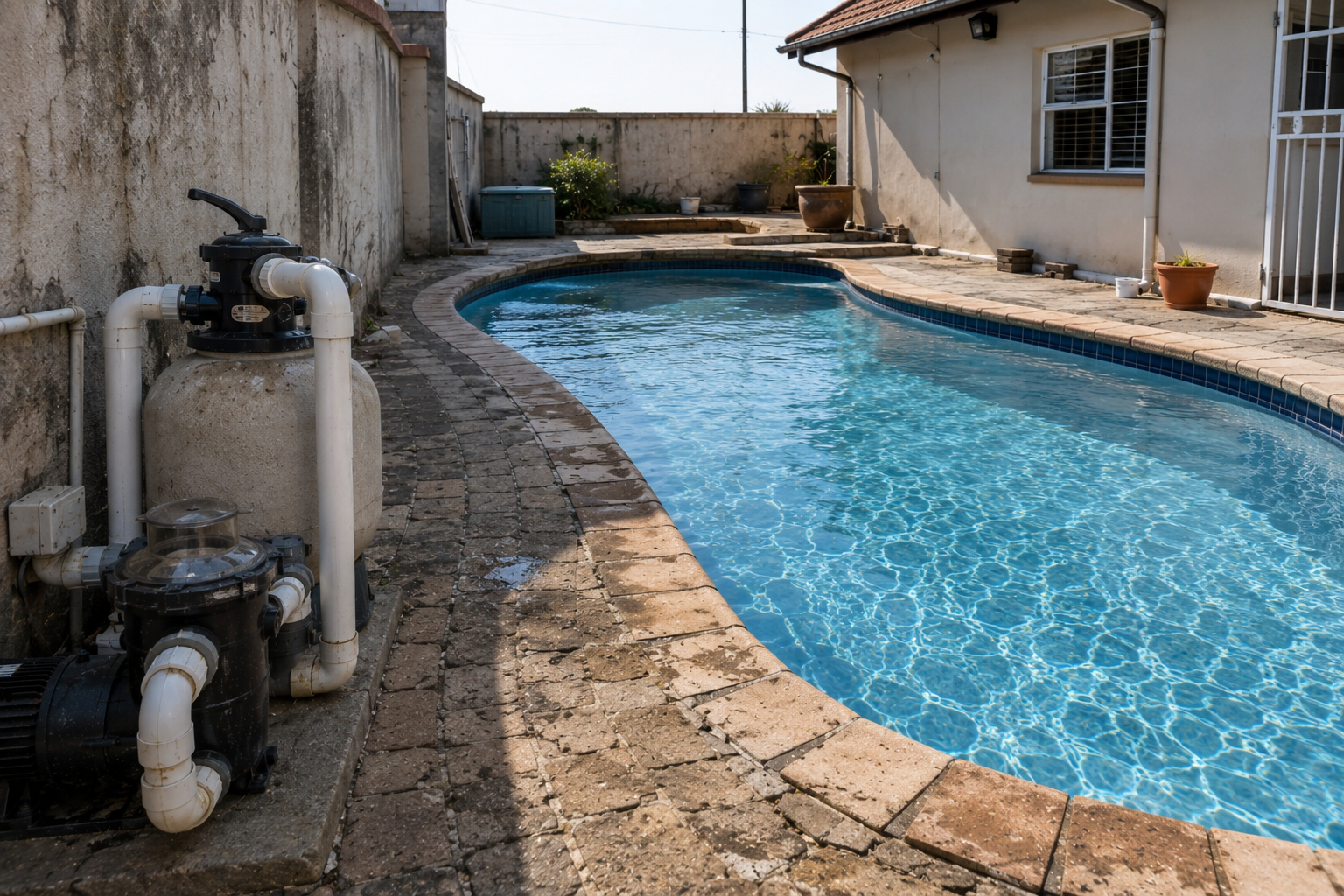
You switch the pool pump off and the water level seems to stay fairly stable. Then the pump runs for a few hours, and you notice that the pool has dropped again.
That pattern can be frustrating because it feels as though the pump itself must be causing the problem.Â
Sometimes it is, but there are several other possibilities that need to be considered before replacing equipment or digging up the pool area.
When the pump is running, water is being pulled from the pool through the suction system, moved through the pump and filter, and pushed back into the pool through the return plumbing.Â
Different parts of that system operate under different conditions, and a leak can behave differently depending on where it occurs.
A damaged return pipe, leaking connection, faulty valve, pump seal, cracked fitting or underground plumbing problem can all result in water loss.Â
A suction-side problem can produce a different set of symptoms, such as air entering the system or the pump struggling to maintain prime.
The fact that the water loss appears to be linked to pump operation is therefore an important clue. It does not provide the diagnosis by itself, but it can help narrow down where we should start looking.
Get Advice on a Pool That Loses Water While Running
Tell us when your pool loses water and what you have noticed while the pump is operating, and we can help determine the most appropriate next step.
Why Does the Pump Make a Difference?
The pool circulation system is not simply moving water from one place to another.
When the pump is switched on, it creates suction on one side and pressure on the other. Water is drawn towards the pump through the suction plumbing, passes through the filtration equipment and is then pushed back towards the pool through the return system.
That change in operating conditions matters when there is a leak.
A small fault in a pressurised return pipe, for example, may release water into the surrounding ground whenever the pump is running.Â
When the pump is switched off, the pressure disappears and the rate of water loss may change considerably.
This can make the pool appear to be losing water only when the pump operates.
A similar situation can occur around exposed equipment. A leaking connection or seal may drip much more noticeably while the system is running than it does when everything is switched off.
On the suction side, the situation can be different again. Instead of seeing water escaping from a pipe, air may be pulled into the system through a damaged connection or pipe.Â
That can affect the way the pump operates and may produce bubbles in the pump basket or at the pool returns.
This is why we do not treat “the pool loses water when the pump runs” as proof that the pump itself has failed.
We look at the complete circulation system.
Is the Pool Pump Actually Leaking?
It is possible.
A pool pump can develop leaks around its lid seal, shaft seal, unions, connections or housing.Â
Depending on the fault, you may see water collecting around the pump or equipment pad while the system is operating.
A small drip can be surprisingly easy to overlook, especially if the water disappears into a drain or runs across the paving.
If you notice water around the pump, watch where it appears to originate rather than immediately assuming the pump needs to be replaced.
Water can travel along pipes and equipment surfaces before reaching the ground. A puddle underneath the pump does not necessarily mean that the pump housing itself is cracked.
The leak could be coming from a nearby union, valve or pipe connection.
This distinction matters because the correct repair depends on the actual source.
At Absolute Pools, we assess the pump and connected circulation system before recommending a repair or replacement.Â
A pump that is still in good condition should not be replaced simply because there happens to be water around it.Â
Our pump repair service covers fault diagnosis, repairs and replacements when replacement is genuinely the more practical option.
What Should You Check Around the Pump?
There are a few things you can observe safely without dismantling the equipment.
Start by looking at the area while the pump is running.
Check for obvious dripping around accessible pipe connections, unions, valves, the pump lid and the pump housing.Â
Look at the paving or surface beneath the equipment for fresh wet patches.
Then switch the pump off and observe what happens.
If the dripping stops almost immediately when the pump stops, that is useful information. It suggests the leak may be associated with the operating circulation system.
If water continues to appear after the pump has stopped, there may be another source that needs to be considered.
You should also listen to the pump.
A change in the sound of the system can sometimes accompany a circulation problem.Â
Grinding, rattling, screeching, humming without starting, overheating and repeated electrical tripping are all reasons to have the pump assessed rather than continuing to operate it and hoping the problem disappears.
Do not open electrical components or dismantle the pump as part of a DIY leak investigation.Â
Water and electrical equipment are an unsafe combination, and a visual inspection is very different from taking the equipment apart.
What If There Is No Water Around the Pump?
This is where an underground plumbing leak becomes more likely.
Pool plumbing is often hidden beneath paving, soil, landscaping or the pool surround. If a pipe develops a crack or separates at a joint, the escaping water may simply disappear into the ground.
You may never see a puddle.
Instead, you might notice that the pool needs topping up more frequently, that one section of paving remains damp or that the water loss becomes noticeably worse after the pump has been running.
The location of damp ground can also be misleading.
Water does not necessarily rise directly above the damaged section of pipe. It can travel through soil or along other pathways before reaching the surface.
That is why randomly lifting paving or digging into the garden is not always a good first step.
We first want to understand the symptoms and narrow down the likely area.
Our pool plumbing repair service covers leaking, cracked and blocked pool pipes as well as affected fittings.Â
When underground plumbing is suspected, the investigation can involve isolating sections of the system or pressure testing selected lines to help identify where the problem is occurring.
Could a Return Pipe Be the Problem?
Yes, and this is one of the more important possibilities when water loss increases while the pump is running.
After water passes through the pump and filter, it travels back towards the pool through the return plumbing.
That side of the system operates under pressure while the pump is running.
If a return pipe has developed a crack, a joint has separated or a fitting has failed, water can escape from the circulation system instead of making its way back into the pool.
If the affected pipe is underground, you may not see the water escaping.
The pool simply appears to be losing water.
This is also why a return-line leak can become much more noticeable when the pump operates for longer periods.Â
The longer the system is circulating, the longer the damaged section is exposed to operating pressure.
A small leak that is difficult to notice during a short pump cycle can therefore become much more obvious over several hours.
The pattern is particularly useful when combined with other observations.
If the pool is stable while the pump is off, loses water during filtration and has no obvious leak around the equipment, return plumbing becomes one of the areas we would want to investigate.
What About the Suction Side?
The suction side can create a very different problem.
Before water reaches the pump, it is being drawn from the pool through the suction system. This includes components such as the skimmer and associated pipework.
If air is entering the suction side through a damaged pipe, loose connection or faulty seal, the pump may start pulling air into the system.
You may notice bubbles inside the pump basket.
You may also see bubbles returning through the pool’s inlet jets.
The pump may struggle to maintain prime or circulation may become weaker than normal.
These symptoms do not automatically prove that an underground suction pipe is damaged.Â
A low pool water level, blocked basket, dirty filter, valve problem or another circulation issue can create similar symptoms.
But when air bubbles, poor suction and unexplained water loss occur together, they are worth investigating.
We look at the circulation system as a whole rather than assuming that every pump problem originates inside the pump.
Why Is My Pool Losing Water Only When the Pump Is Running?
There is another useful question to ask:
Does the pool lose water only when the pump is running, or does the pump simply make an existing leak more noticeable?
That distinction is important.
A pool can have a leak that continues regardless of whether the circulation system is operating. The pump may simply make the water loss easier to notice because the system is active.
For example, a leak from the pool shell, skimmer or another fitting may continue while the pump is off. In contrast, a leak in pressurised return plumbing may become significantly worse while the pump is operating.
At Absolute Pools, we use the pattern of water loss as one part of the investigation rather than treating it as a diagnosis by itself.
Our leak detection service considers the pool shell, fittings, skimmer, plumbing and equipment when looking for unexplained water loss.Â
Depending on the symptoms and pool design, the investigation may involve water-level monitoring, dye testing, isolating sections of the circulation system or pressure testing selected plumbing lines.
That approach matters because the point where you notice the water is not necessarily where it is escaping.
Could Evaporation Still Be Responsible?
It is possible, although the pump-running pattern makes it worth looking more closely at the circulation system.
Outdoor pools naturally lose some water through evaporation. Wind, temperature, exposure to the sun and normal pool use can all affect how quickly this happens. Splashing and backwashing can also contribute to water loss.
If you are unsure whether the pool is actually leaking, the bucket test can help compare water loss from the pool with evaporation under the same conditions.
The bucket test does not tell you where a leak is located. It simply helps establish whether the pool appears to be losing water faster than evaporation can reasonably explain.
That makes it useful as an initial check.
If the bucket test suggests that the pool is losing an abnormal amount of water, the next step is to work out where that water is going.
The pump-running pattern then becomes another useful piece of information.
What Does It Mean if the Pool Level Drops More With the Pump On?
A noticeable difference between pump-on and pump-off water loss can point towards a circulation-related problem.
It does not necessarily identify the exact component.
For example, we might consider the return plumbing, pump connections, valves, filter connections and other pressurised parts of the system.
If the water continues dropping at a similar rate when the pump is off, we would also consider the pool shell, skimmer, fittings and suction-side plumbing.
The key is to look at the complete pattern.
This is why telling us exactly what you have observed is useful when arranging a pool leak assessment.Â
“The pool is losing water” is helpful, but “the pool barely drops overnight while the pump is off, then loses noticeably more after six hours of filtration” gives us much more information to work with.
Can a Dirty Filter Cause Water Loss?
A dirty filter does not automatically mean that water is leaking from the pool.
However, problems with the filtration system can affect circulation and may be connected to unexpected water discharge depending on the equipment and how it is being operated.
Backwashing is an obvious example.
When a filter is backwashed, water is deliberately discharged from the system. That water needs to be replaced in the pool afterwards.
If the pool is losing water during normal filtration, however, rather than during a deliberate backwash, that is a different situation.
A faulty valve, damaged filter component, leaking connection or problem with the backwash system may need to be investigated.
The filter should therefore be considered as part of the wider circulation system rather than treated as a completely separate component.
Could a Valve Be Causing the Water Loss?
Yes.
Pool circulation systems contain valves that control where water moves through the system.
A damaged valve, worn seal or faulty connection can allow water to escape or can prevent the system from operating as intended.
The problem may be visible around the equipment, but not always.
A valve connected to underground plumbing can be associated with water loss that is much harder to trace.
We also need to consider whether the valve is directing water somewhere it should not be going.
If the circulation system has been altered recently, or if a component has been replaced before the water-loss problem began, that history is useful.
Changes to plumbing, equipment or pool fittings can sometimes provide an important clue about when a problem started.
What If the Pump Is Losing Prime?
A pump that repeatedly loses prime should be investigated rather than continually restarted.
Prime allows the pump to move water properly through the circulation system. If air is entering the suction side, the pump may struggle to maintain normal operation.
A low pool water level can also create problems because the skimmer may begin drawing air instead of maintaining a proper water supply to the pump.
Blocked baskets, dirty filters, damaged valves and blocked plumbing can also affect circulation.
This is why pump symptoms need to be considered in context.
At Absolute Pools, we assess the pump together with the connected circulation system when diagnosing pump problems.Â
Weak circulation, air in the system or difficulty maintaining prime does not automatically mean the pump motor itself has failed.
Should You Keep Running the Pump?
That depends on what the pump is doing.
If the pump is operating normally and you are simply investigating unexplained water loss, recording the pattern can be useful.
If the pump is overheating, repeatedly tripping, producing a burning smell, making severe mechanical noises or running without adequate water, it should not simply be left running while you wait for the problem to resolve itself.
A pump running dry can suffer damage, while an electrical or mechanical fault can become more serious if operation continues.
If you are unsure whether the equipment is safe to operate, switch it off and arrange an assessment.
What Should You Record Before Calling for Help?
You do not need specialist equipment to provide useful information about the problem.
Pay attention to how quickly the water level changes and whether the pump was operating during that period.
It can also help to note whether you have seen wet ground, water around the equipment, air bubbles in the pump basket, weaker suction or weaker return flow.
If you recently had work done on the pool, changed equipment, replaced plumbing or noticed a problem after a particular event, mention that as well.
The more accurately we understand the pattern, the easier it is to determine what needs to be investigated.
Let’s Trace the Source Before You Replace Anything
If your pool loses noticeably more water while the pump is running, Absolute Pools can assess the pool, equipment and circulation system to identify the likely source before repair work is recommended.
Why You Should Not Immediately Replace the Pump
It is understandable to look at a leaking pool and a running pump and conclude that the pump must be responsible.
But replacing the pump will not solve a leaking underground return pipe.
It will not repair a cracked fitting.
It will not seal a damaged valve.
And it will not stop water escaping through a pool shell or skimmer.
The same applies in reverse. If the pump itself has developed a genuine mechanical or sealing problem, repairing an underground pipe will obviously not resolve the equipment fault.
The solution needs to match the source.
This is particularly important with older pool systems, where several components may have experienced wear over the years.
A pump can be functioning reasonably well while an old pipe connection begins to fail. A pool can have ageing plumbing and a perfectly serviceable pump.
A leaking fitting can make the entire system appear to have a major equipment problem when the actual repair is much more localised.
Our approach at Absolute Pools is to assess the problem before deciding whether the appropriate solution is a repair, replacement, plumbing work, leak detection or, where wider deterioration exists, a more extensive restoration.
Repair or Replace? It Depends on What We Find
Not every pump-related water-loss problem requires a new pump.
A repair may be practical when the pump itself is still in good condition and the problem involves a replaceable component such as a seal, gasket, O-ring or another damaged part.
Replacement can make more sense when the pump housing is damaged, the motor has suffered significant failure, compatible parts are difficult to obtain or continued repairs no longer make economic sense.
We also need to consider whether the pump is correctly suited to the pool’s circulation requirements.
An incorrectly sized pump can create circulation problems and place unnecessary demands on other parts of the system.
The pool volume, plumbing layout, filter capacity and other equipment should be considered when selecting a replacement.
That is why “just replace the pump” is rarely a good diagnostic strategy.
What If the Leak Is Underground?
Underground leaks are among the more frustrating pool problems because you cannot easily see what is happening.
The pipe may be beneath paving, soil or landscaping.
There may be no obvious puddle.
The only visible symptom may be a pool that needs topping up repeatedly.
In some cases, damp ground or sinking paving can provide a clue. Escaping water can affect the soil surrounding the pipe and, over time, contribute to movement or instability around paved areas.
But the absence of damp ground does not rule out an underground leak.
The water may be travelling away from the damaged section or disappearing into surrounding ground without producing an obvious surface indication.
This is where proper leak detection becomes valuable.
Rather than immediately lifting large sections of paving, we can use the symptoms and appropriate testing methods to narrow down the likely source.
Our leak detection service is designed to investigate water loss before recommending the repair required.
What Happens During a Pool Leak Investigation?
The investigation starts with the symptoms.
We want to understand how quickly the pool is losing water, whether the pump changes the rate of loss, when the problem started and whether any work has recently been carried out on the pool or equipment.
We then consider the pool itself and the circulation system.
The pool interior, waterline, fittings, skimmer, visible plumbing and equipment can all provide useful clues. Depending on what we find, further testing may be appropriate.
Water-level monitoring can help establish the pattern of loss.
Dye testing can sometimes help investigate suspected localised leaks.
Sections of the circulation system can be isolated to determine whether the water loss changes.
Pressure testing can be used on selected plumbing lines when an underground leak is suspected.
The method depends on the pool and the symptoms. There is no reason to use the same test for every leaking pool.
The objective is to narrow down the source sufficiently to recommend the appropriate repair rather than making an expensive guess.
What Happens Once the Leak Is Found?
Once we know where the water is escaping, the repair can be planned around the actual problem.
A localised fitting leak may require a relatively straightforward repair.
A damaged section of accessible plumbing may be repaired or replaced.
An underground pipe may require access to the affected area.
A leaking pump connection may require a seal, fitting or connection to be repaired.
If the problem is connected to the pool shell, the repair may involve the damaged surface, a crack or another structural or finish-related issue.
The condition of the surrounding area matters too.
A small isolated problem can often be dealt with as a repair. If the pool has widespread surface deterioration or structural damage, however, patching one area may not address the underlying condition.
Absolute Pools provides pool crack and structural repairs, resurfacing and relining, fibreglass repairs and relining, Marbelite repairs and re-Marbelite, as well as pool plumbing and equipment repairs. The appropriate solution depends on the condition of the pool and the nature of the problem.
How Much Does This Type of Repair Cost?
There is no useful fixed price for a pool that loses water when the pump is running.
The cost depends on what we find.
A leaking connection beside the pump is very different from an underground return pipe beneath a paved pool surround. A shell leak is different again.
The size and design of the pool, accessibility of the suspected leak, testing required, extent of damage, materials and labour can all influence the final cost of the work.
Leak detection and repair are also not necessarily the same job.
The first stage may involve determining where the water is escaping. The repair then depends on what that investigation reveals.
At Absolute Pools, we assess the situation and recommend a practical repair route based on the condition of the pool and access to the affected area.
This allows the repair to be quoted according to the actual problem rather than an assumption about what might be wrong.
Do Not Ignore a Pool That Keeps Losing Water
It can be tempting to keep topping up the pool and carry on using it.
That may seem harmless when the water loss is relatively small.
But a persistent leak does not become less significant simply because the pool is still usable.
Continually replacing lost water also means continually replacing some of the chemicals that leave the pool with that water. More importantly, the water may be escaping somewhere you cannot see.
If the level falls too far, the skimmer may stop operating correctly and the pump can begin drawing air.
Water escaping beneath paving or around the pool can also affect the surrounding ground.
A leak does not have to produce a dramatic stream of water to justify investigation.
Sometimes the first sign is simply that you are topping up the pool far more frequently than you used to.
The Pump-Running Pattern Is a Clue, Not a Diagnosis
If your pool seems to hold its water while the pump is switched off but loses noticeably more when the pump is operating, pay attention to that pattern.
It can point towards a problem in the circulation system, particularly pressurised return plumbing or equipment connections.
But it does not prove that the pump itself has failed.
A suction-side problem can introduce air into the system. A leaking valve or connection can cause water loss. An underground return pipe can release water beneath the property.
A pump seal or housing can leak. A pool fitting or shell problem may also need to be considered.
The most useful approach is to look at the entire system and establish exactly what is happening.
Start by observing the water level.
If you are unsure whether the pool is genuinely leaking, use the bucket test to compare the pool’s water loss with evaporation.
Look around the accessible equipment while the pump is running, but do not dismantle electrical or mechanical components.
Pay attention to bubbles, changes in suction, unusual pump noises, wet ground and changes in water loss between pump-on and pump-off periods.
Then, if the pattern continues, have the source properly investigated rather than replacing components based on guesswork.
At Absolute Pools, we approach pool water loss by looking at the complete system. We can investigate the pool, fittings, plumbing and equipment and then recommend the appropriate repair based on what we find.
That may mean a simple repair.
It may mean plumbing work.
It may mean pump repair or replacement.
And if the investigation uncovers wider damage to the pool, we can explain what additional restoration may be appropriate.
The important thing is to find out where the water is actually going before deciding what needs to be fixed.
Book a Pool Leak Assessment
Fill in the form below and tell us how quickly your pool is losing water and when you first noticed the problem. Our team will contact you to discuss the next step.


Comments are closed