


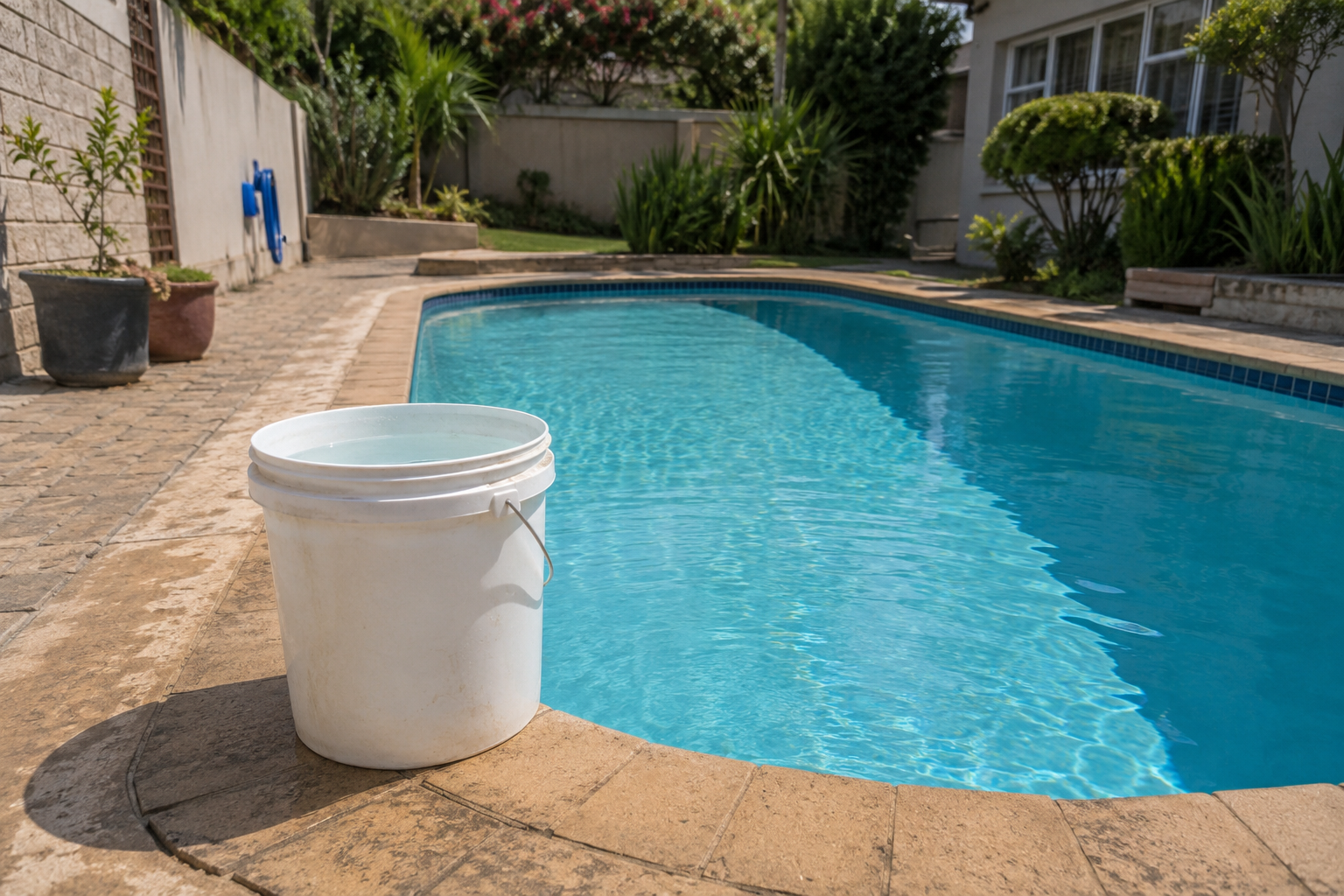
You top up the pool, check it again a few days later and notice the water level has dropped. During a hot spell, that may not seem unusual. Sun, wind and dry air can all increase evaporation, particularly when the pool is uncovered.
But what happens when the water keeps disappearing?
That is when it becomes important to distinguish normal evaporation from a possible pool leak. The two can look very similar, especially during hot weather. A pool may lose a noticeable amount of water without having anything wrong with it, while a small leak can quietly continue for weeks before the water loss becomes obvious.
Fortunately, there is a simple test you can perform at home to get an initial indication of what is happening.
The bucket test compares the water loss from your pool with the evaporation occurring from a separate container exposed to similar conditions. If the pool loses roughly the same amount as the bucket, evaporation is likely responsible. If the pool loses considerably more, there may be a leak that needs further investigation.
The test is not a substitute for professional leak detection, and it cannot tell you where a leak is located. What it can do is help answer the first and most important question: is the pool losing more water than evaporation can reasonably explain?
Book a Pool Leak Assessment
Fill in the form below and tell us how quickly your pool is losing water and when you first noticed the problem. Our team will contact you to discuss the next step.
Why Does a Swimming Pool Lose Water?
Every swimming pool loses some water.
The most obvious reason is evaporation. Pool water is constantly exposed to the atmosphere, and some of it changes from liquid into water vapour and disperses into the surrounding air.
The amount of evaporation varies considerably. A pool exposed to direct sunlight, warm temperatures and strong wind can lose water much faster than a pool protected from the elements.
Wind is particularly influential. Moving air removes the layer of humid air sitting immediately above the surface of the pool, allowing more water to evaporate. This is why water loss can become much more noticeable during hot, windy weather.
Pool water temperature also plays a role. Warmer water generally evaporates more readily, particularly when the surrounding air is dry.
Then there is normal pool activity.
People getting in and out of the pool carry water onto the surrounding paving. Swimming and splashing can remove water from the pool, while children playing in the water can result in considerably more water being displaced. Some of this eventually makes its way back into the pool, but some does not.
Pool maintenance can also account for water loss. Backwashing a filter, for example, deliberately sends water out of the system.
None of these things indicates a leak.
The challenge is recognising when water loss has gone beyond what can reasonably be explained by evaporation and normal use.
How Can You Tell if a Pool Is Leaking?
There is no single visual sign that proves a pool is leaking.
Sometimes the evidence is obvious. You may notice a crack, damaged fitting or persistent wet area around the pool. In other cases, there may be no visible indication at all.
A change in your normal water usage can be one of the first clues.
If you usually top up your pool occasionally but suddenly find yourself adding water every few days, something has changed. That does not necessarily mean the pool is leaking, because a period of unusually hot or windy weather can increase evaporation, but the change is worth investigating.
The water level can provide another clue.
If the pool continues to drop noticeably even after weather conditions change, or if it consistently loses substantially more water than expected, a leak becomes more likely.
You may also notice damp paving, wet soil or an unusually moist area around the pool. These signs can sometimes indicate escaping water, although they can also be caused by irrigation, rain or drainage problems.
A leak can be particularly difficult to spot when it occurs underground. Water escaping from a buried pipe may disperse into the surrounding soil rather than appearing as an obvious puddle on the surface.
That is why a visual inspection alone cannot always answer the question.
What Is the Pool Bucket Test?
The bucket test is a simple way of comparing evaporation with the water loss occurring in the pool.
You place pool water into a bucket and expose it to the same general environmental conditions as the pool. Both the pool and the bucket are then marked and left for a period of time.
Because the water in the bucket is exposed to the same weather, it provides a useful reference for evaporation.
If the pool and bucket lose approximately the same amount of water, evaporation is likely responsible for most of the loss.
If the pool loses significantly more water than the bucket, evaporation alone is unlikely to explain the difference.
That is the basic principle behind the test.
It is worth stressing that the bucket test does not locate a leak. It cannot tell you whether water is escaping through a pipe, fitting, pool surface or another component. It simply indicates whether there may be abnormal water loss that deserves closer attention.
What Do You Need for a Bucket Test?
You do not need specialist equipment.
A sturdy bucket, some pool water and a waterproof marker or another reliable way of marking the water levels are enough.
The bucket needs to remain stable throughout the test. If it moves, tips, loses water through splashing or allows pool water to enter, the comparison becomes unreliable.
Ideally, it should also be exposed to broadly similar conditions to the pool.
This point is more important than it might initially seem.
The purpose of the bucket is to measure evaporation. If the bucket is placed somewhere sheltered from wind while the pool is exposed to strong airflow, the bucket may evaporate less water simply because its conditions are different.
You are not trying to create a laboratory experiment. You are trying to make the comparison as fair as reasonably possible.
How to Do the Bucket Test
The test itself is straightforward, but taking care with the setup makes the result much more useful.
Fill the bucket with pool water
Take water from the pool and put it into a sturdy bucket.
There is no need to fill the bucket completely. Leave enough space to prevent the water from easily splashing over the edge.
Place the bucket securely on a pool step or another suitable location where it will remain stable.
If you place it on a pool step, make sure the bucket is positioned so that water from the pool cannot freely splash into it.
Mark the starting level
Mark the water level inside the bucket.
You then need to establish a clear reference point for the pool’s water level. This can be marked on the bucket itself if it is positioned appropriately, or against another suitable fixed reference point.
The important thing is that you know exactly where both water levels started.
Leave everything undisturbed
Allow the test to run for roughly 24 hours.
During this period, avoid swimming if possible. Do not deliberately disturb the bucket, and do not top up the pool while the test is underway.
If someone does use the pool or if the pool receives significant splashing, make a note of it because that can affect the result.
Weather conditions should also be considered. Heavy rain, unusually strong winds or another significant change can affect the comparison.
Compare the water levels
After the test period, compare the new levels with your original marks.
You are looking at how much water each has lost.
If the pool and bucket have dropped by approximately the same amount, evaporation is the likely explanation.
If the pool has dropped substantially more than the bucket, the difference suggests that something other than evaporation may be causing additional water loss.
Why Does the Bucket Need to Be Exposed to Similar Conditions?
The bucket is essentially your evaporation reference.
If the conditions around it are completely different from those around the pool, the comparison becomes much less useful.
For example, imagine a pool sitting in full afternoon sun while the bucket is placed under a covered patio. The pool is receiving substantially more solar exposure, so it may naturally lose more water.
The same applies to wind.
A bucket protected by a wall will not necessarily evaporate water at the same rate as a pool exposed to an open, windy area.
The bucket should therefore be placed where it experiences broadly similar sunlight, temperature and airflow.
Perfectly identical conditions are impossible, and they are not necessary. The goal is simply to avoid obvious differences that could distort the result.
How Long Should You Run the Bucket Test?
Around 24 hours is a practical starting point because it provides enough time for a measurable difference to develop without creating too many opportunities for the test to be disturbed.
If the result is obvious, you may have enough information after one test.
If the difference is very small, however, repeating the test can be useful.
A single test can be affected by a range of factors. Someone may have splashed water out of the pool, the bucket may have moved slightly or the weather may have changed unexpectedly.
Repeating the test under reasonably similar conditions gives you a better indication of whether the pattern is consistent.
You are looking for evidence rather than absolute mathematical certainty.
How Do You Interpret the Bucket Test Results?
The most important thing is the difference between the two water levels.
Suppose the bucket loses a small amount of water and the pool loses approximately the same amount.
That is consistent with evaporation.
Now suppose the bucket loses only a small amount but the pool level falls considerably further.
That is more significant.
A pool that repeatedly loses more water than the bucket is harder to explain through evaporation alone.
There is no universal measurement that says exactly how many millimetres of difference automatically proves a leak. Evaporation depends on local weather and pool conditions, and the accuracy of the test depends on how carefully it was performed.
For that reason, the bucket test should be treated as an indication rather than a definitive diagnosis.
If the result is marginal, repeat it.
If the difference is substantial and consistent, further investigation is sensible.
What If the Pool Loses More Water Than the Bucket?
Do not immediately assume that the pool has a major structural crack.
A failed bucket test tells you that the pool appears to be losing more water than evaporation can explain. It does not tell you why.
There are several possible sources.
Water may be escaping through the pool structure, a fitting, a joint or part of the circulation system. Underground pipework can also be involved, and that can be particularly difficult to identify because the escaping water may disappear into the surrounding ground.
This is where professional assessment becomes useful.
Trying to repair the first problem you notice may not solve the actual cause. A visible crack, for example, may look suspicious but may not be responsible for the water loss.
The source needs to be identified before the appropriate repair can be chosen.
Look at Where the Water Level Stops
The level at which the pool stops losing water can sometimes provide an important clue.
Suppose the pool level consistently drops until it reaches a particular point and then the loss slows down or stops. That level may correspond with a fitting, opening or another part of the pool.
This does not prove that the component at that height is responsible, but it is useful information.
If you notice a consistent stopping point, make a note of it.
It can help establish what should be investigated.
The same applies to changes in water loss when the pool equipment is operating.
If the pool seems to lose water more quickly when the pump is running, that observation is worth recording. It may suggest that the circulation system needs closer attention.
You should not dismantle electrical equipment or pressurised plumbing yourself simply to investigate the issue. Observing the pattern is useful. Taking apart the system without knowing what you are looking for can create additional problems.
What Are Some Other Signs of a Pool Leak?
Water loss is usually the main symptom, but other signs can provide useful context.
Persistent dampness around the pool is one.
If a section of paving or soil remains unusually wet when there has been no recent rain or irrigation, it may be worth investigating. In some situations, escaping water can move beneath the surface and appear some distance away from the actual source.
A visible crack or damaged fitting is another reason to take a closer look, particularly when it appears alongside unexplained water loss.
You may also notice that the pool requires significantly more frequent topping up than it used to.
Changes in equipment behaviour can provide clues as well. If the circulation system is behaving differently at the same time that water loss has increased, the two issues may be related.
None of these observations should be treated as proof on their own.
The most useful approach is to consider them together.
Can a Pool Leak Without Leaving a Puddle?
Absolutely.
This is one of the reasons pool leaks can be frustrating to diagnose.
Water escaping from underground plumbing does not necessarily collect on the surface. It may move into surrounding soil, depending on the ground conditions and the location of the pipe.
Similarly, water escaping from a structural problem may not produce a large visible puddle.
The absence of standing water therefore does not rule out a leak.
If the bucket test repeatedly indicates abnormal water loss, it is worth investigating even if the area around the pool looks completely dry.
Does a Pool Leak Always Mean There Is a Crack?
No.
A leaking pool does not necessarily have a damaged shell.
The source may be a plumbing line, fitting, joint or another part of the system.
This distinction matters because the repair depends on the cause.
Repairing a visible crack will not solve a leak in underground pipework. Replacing a pump will not solve a damaged pool fitting. Applying a patch to an accessible area without confirming that it is the source can simply delay the proper repair.
A proper assessment should therefore establish where the water is escaping before deciding what work is required.
What Happens if You Keep Topping Up a Leaking Pool?
Topping up the pool may keep the water level where it needs to be temporarily, but it does not solve the underlying problem.
If the pool genuinely has a leak, you are continually replacing water that is disappearing somewhere else.
There can also be a tendency to become accustomed to the extra maintenance. A pool that needs topping up every few days can start to feel normal, particularly if the water level always looks acceptable when you check it.
That can allow a developing problem to go unnoticed.
A better approach is to pay attention to changes in your normal pool routine.
If you suddenly need substantially more water than before, find out why.
The goal is not to assume there is a serious problem every time the water level drops. It is to avoid dismissing persistent abnormal water loss as “just evaporation.”
Book a Pool Leak Assessment
Fill in the form below and tell us how quickly your pool is losing water and when you first noticed the problem. Our team will contact you to discuss the next step.
Can You Reduce Evaporation From Your Pool?
You cannot eliminate evaporation completely, but you can reduce unnecessary water loss.
A properly used pool cover can limit the amount of water exposed directly to the atmosphere. This can be particularly useful when the pool is not being used for extended periods.
Reducing unnecessary splashing also helps, although this is naturally more difficult to control when the pool is being actively used.
Good maintenance makes a difference as well.
A pool that is kept in good condition is easier to monitor because changes in its normal behaviour are more obvious. If you know how frequently you typically need to add water, an unexpected increase is easier to identify.
It is important, however, not to confuse evaporation prevention with leak repair.
A cover can reduce evaporation.
It cannot stop water escaping through damaged plumbing or a compromised pool structure.
Why Hot, Windy Weather Can Be Misleading
A period of hot and windy weather can make a small leak particularly difficult to identify.
Consider a pool that already has a minor leak. Under mild weather conditions, the water loss may be slow enough to go unnoticed.
Then temperatures rise, the air becomes drier and strong winds increase evaporation.
The pool suddenly appears to be losing a lot more water.
The weather may not have caused the leak. Instead, normal evaporation has increased at the same time as the existing leak continues.
This is precisely why comparing the pool with a bucket can be useful.
If the bucket also loses noticeably more water during the hot weather, increased evaporation is clearly contributing to the loss.
If the pool’s loss is substantially greater than the bucket’s, there is more reason to investigate.
What About Rain During the Test?
Rain can complicate the bucket test because it adds water to both the pool and the bucket.
The amount of rainfall collected can also differ depending on the position and surface area of each.
For this reason, a period of heavy rain is not ideal for the test.
If significant rainfall occurs while you are testing, record what happened and consider repeating the test during a more stable period.
The same applies to unusually strong weather conditions.
A test performed during an exceptional storm may tell you less than a test performed during ordinary conditions because too many variables have changed.
Should You Test With the Pool Pump Running?
The pump can provide another useful observation, but it should not be treated as a replacement for the bucket test.
If you notice that water loss appears to increase while the circulation system is operating, make a note of it.
This can be relevant because the pool’s plumbing system is under different operating conditions when the pump is running.
If the water loss appears to change depending on whether the equipment is operating, that information can help direct further investigation.
However, avoid dismantling equipment yourself, especially where electrical connections or pressurised components are involved.
Observation is useful.
Unnecessary interference with the system is not.
What if the Bucket Test Shows Normal Evaporation?
That is good news.
If the pool and bucket lose approximately the same amount of water, there is less evidence of a leak.
It does not mean that every possible leak has been ruled out with absolute certainty, particularly if the test conditions were not ideal. A very small leak may also be difficult to distinguish from ordinary evaporation.
If the pool continues behaving unusually, you can repeat the test or have the issue assessed.
The important thing is not to create a problem where there isn’t one.
If the evidence points towards ordinary evaporation, there may be no repair required.
What If the Bucket Test Shows a Clear Difference?
A clear and repeatable difference deserves attention.
At that point, the useful question is no longer whether evaporation is occurring. It almost certainly is.
The question is where the additional water is going.
This is where professional leak detection can be valuable.
The source could be somewhere that is not visible from the pool deck. It could involve pipework, fittings or the pool structure. The appropriate investigation depends on the type of pool and the symptoms being observed.
Once the source has been identified, the repair can be considered based on the actual problem.
That may be a relatively straightforward repair, or it may reveal a broader issue with the pool that needs more comprehensive attention.
Pool Leak Repair or Pool Renovation?
A leak does not automatically mean that the entire pool needs to be renovated.
If the pool is otherwise in good condition and the problem is isolated, a targeted repair may make perfect sense.
An older pool can be different.
If there are several issues at once, such as deterioration of the pool surface, ageing components, previous repairs and persistent water loss, it may be worth considering the overall condition rather than looking at the leak in isolation.
The right decision depends on the actual condition of the pool and the cause of the water loss.
A professional assessment can help distinguish between a problem that calls for a specific repair and one that forms part of a larger renovation requirement.
How Much Does It Cost to Repair a Leaking Pool?
There is no useful one-size-fits-all price for pool leak repairs.
The cost depends on what is actually wrong.
A leak in an accessible component can be very different from one involving concealed pipework or damage that requires additional preparation to reach.
Other factors can also influence the cost, including the size and type of pool, the location and extent of the damage, materials required, accessibility, labour and whether additional problems are discovered during the repair.
This is why the most useful first step is identifying the cause.
Once you know what needs to be repaired, you have a much clearer basis for discussing the scope of work and the associated cost.
Common Mistakes When Investigating Pool Water Loss
One of the biggest mistakes is assuming that every drop in water level means there is a leak.
Evaporation is normal, and the rate can increase substantially during hot or windy weather. Pool use can also account for some water loss.
Another mistake is assuming that a leak must leave a visible puddle.
Underground water loss may not be obvious at all. Escaping water can disperse into surrounding ground rather than collecting on the surface.
It is also a mistake to repair the first visible defect without confirming that it is responsible for the water loss.
A crack may be unrelated. A fitting may look worn without actually being the source. A patch may temporarily conceal a symptom without addressing the underlying cause.
The bucket test itself can also be performed incorrectly. If the bucket is sheltered while the pool is exposed to strong wind, or if the pool is used repeatedly during the test, the comparison becomes less reliable.
Finally, relying on one inconclusive test can lead to the wrong conclusion.
If the difference is small, repeat the test.
If the difference is substantial and consistent, investigate further.
When Should You Call a Professional?
A simple bucket test is a sensible first step when you are unsure whether your pool is losing water through evaporation or a leak.
Professional assistance becomes more appropriate when the test repeatedly shows a significant difference, when the pool requires unusually frequent topping up or when other warning signs are present.
A visible crack, persistent dampness around the pool, suspected underground plumbing problems or a noticeable change in water loss are all reasons to take the issue seriously.
The goal is not simply to confirm that the pool is losing water.
You already know that if you are continually adding water.
The goal is to identify the cause.
That distinction matters because the right repair can only be chosen once the underlying problem is understood.
A Simple Test Can Prevent a Lot of Guesswork
A swimming pool losing water is not automatically a cause for concern. During hot, dry or windy weather, evaporation can account for a surprisingly noticeable amount of water loss.
The bucket test provides a practical way to establish whether the pool appears to be losing substantially more water than evaporation alone would explain.
Set up the bucket carefully, expose it to similar conditions, mark both starting levels and compare the results after roughly 24 hours. If the two losses are similar, evaporation is the likely explanation. If the pool consistently loses considerably more water, it is worth investigating further.
Pay attention to the other clues as well. Changes in how often you top up the pool, the level at which water loss stops, damp areas around the pool and differences in water loss when equipment is operating can all provide useful information.
Most importantly, do not assume that a leak must be a visible crack or that a puddle must appear before there is a problem. Pool leaks can occur in places that are difficult to see, including underground plumbing and concealed components.
The bucket test is therefore best viewed as a starting point. It can help you decide whether further investigation makes sense, but identifying the actual source of a leak requires a closer assessment.
If your pool continues to lose water and the bucket test suggests that evaporation is not the whole explanation, addressing the problem sooner rather than simply continuing to top up the pool can help prevent an ongoing water-loss issue from becoming a larger repair concern.
Book a Pool Leak Assessment
Fill in the form below and tell us how quickly your pool is losing water and when you first noticed the problem. Our team will contact you to discuss the next step.

Comments are closed