


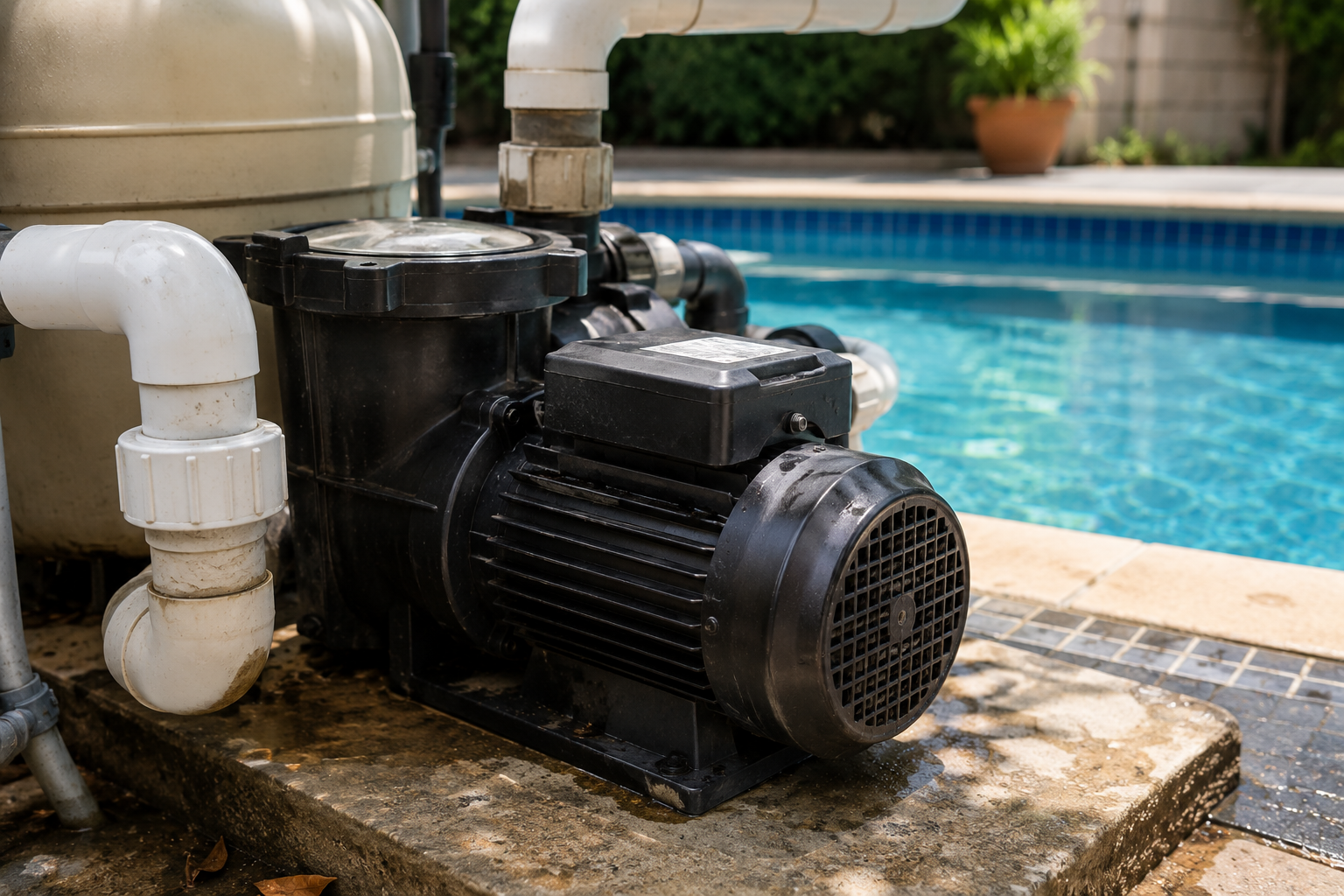
You switch the pool pump on and hear a low, steady hum from the motor. It sounds as though the pump is trying to start, but the motor never gets going.
That is different from a pump that is completely silent.
A humming pump is receiving some electrical power, but something is preventing the motor from starting and turning the impeller as it should. The cause can be relatively simple, such as a failed starting capacitor, or it can point to a mechanical or electrical fault that needs proper attention.
The important thing is not to keep switching the pump on and off hoping that it will eventually start. A motor that hums without turning can generate heat quickly, and repeated attempts to start it can make an existing fault worse.
At Absolute Pools, we repair pool pumps and other pool equipment as part of our wider pool repair and maintenance services in Midrand. We look at the pump itself as well as the circulation system around it, because the sound you hear is not always enough to identify the actual problem.
Is Your Pool Pump Making a Humming Sound?
If your pump hums but the motor will not start, Absolute Pools can assess the equipment and help determine whether the problem is repairable or whether replacement makes more sense.
What Does a Humming Pool Pump Usually Mean?
A humming sound generally means the motor is receiving power but is unable to get itself rotating properly.
A pool pump motor needs enough electrical and mechanical assistance to start turning. Once it is running, the motor can continue operating normally. If something prevents that initial movement, you may hear the characteristic hum while the motor remains stationary.
There are several possible reasons.
The starting capacitor may have failed. The impeller may be jammed by debris. The motor bearings may be worn or seized. There may be an electrical supply problem. Internal motor components may have deteriorated. In some cases, the pump may be affected by another problem in the circulation system.
This is why replacing the entire pump immediately is not always the best first step.
The pump may have a repairable fault.
On the other hand, if the motor is old and several components are already deteriorating, repairing one part may not provide the best long-term outcome.
The condition of the equipment matters just as much as the symptom.
The Starting Capacitor Is a Common Suspect
One of the first things that may need to be investigated when a pool pump hums but does not start is the motor’s starting capacitor.
The capacitor helps provide the electrical boost the motor needs to start turning. If it fails, the motor can receive power without developing the necessary starting force.
The result can be very characteristic: you switch the pump on, hear a hum, but the motor does not begin running.
A failed capacitor does not necessarily mean that the motor itself has reached the end of its life.
If the rest of the pump is in reasonable condition, replacing the failed component may restore normal operation.
This is one of the reasons a humming pump should be diagnosed before a replacement pump is purchased.
There is little value in replacing an otherwise serviceable pump because of one failed component.
The opposite can also be true. If the pump has been running for many years and the capacitor has failed alongside worn bearings, damaged seals or other internal problems, a more extensive repair may not make financial sense.
The right decision depends on the condition of the complete pump.
A Jammed Impeller Can Also Stop the Motor
The impeller is responsible for moving the water through the pump.
If debris becomes lodged in or around the impeller, the motor may struggle to rotate.
Leaves, small pieces of debris or other material can sometimes find their way into the pump system despite the presence of baskets and filtration components.
When the impeller cannot move freely, the motor may attempt to start but fail to turn properly.
That can produce the humming sound you are hearing.
There is an important distinction here between checking an accessible pump basket and opening up the motor or pump assembly.
Emptying a pump basket is a normal maintenance task when the equipment is designed for the owner to access it safely.
Working inside an electrically powered pump is different.
The power should be isolated properly before any inspection that involves opening electrical or mechanical components, and electrical repairs should not be treated as a casual DIY job.
If you are unsure why the motor is humming, it is safer to stop repeatedly trying to start it and have the equipment assessed.
Worn Bearings Can Cause a Humming or Stalled Motor
Pool pump motors contain moving parts that experience wear over time.
Bearings allow the motor shaft to rotate. When they become worn, damaged or seized, the motor may become increasingly noisy or eventually struggle to start.
A pump with bearing problems may give you warning signs before it stops completely.
You might notice a grinding, rattling or increasingly loud sound during normal operation. The pump may become hotter than usual or develop unusual vibration.
Eventually, the motor may struggle to turn at all.
If the pump has been making unusual noises for some time and has now progressed to humming without starting, the humming may be the final symptom of a problem that has been developing gradually.
This is why an unusual pump noise should not always be dismissed as an annoyance.
A noisy pump is not necessarily about to fail, but a change in sound can tell you that something inside the equipment deserves attention.
Could the Pool Pump Be Overheating?
Heat can become a problem when a motor is unable to start.
A motor that remains energised while failing to rotate can generate heat. If you repeatedly switch it on, allow it to hum, switch it off and then try again, you may be putting additional strain on the motor.
Some pumps have thermal protection designed to shut the motor down if it becomes too hot.
That protection is useful, but it should not be treated as a reason to keep restarting a faulty pump.
If the motor repeatedly trips its thermal protection, that is a sign that something needs to be investigated.
The underlying cause could be electrical, mechanical or related to the pump’s operating conditions.
A pump that overheats may also have another problem affecting water flow, so the diagnosis should consider the complete system rather than assuming the motor is automatically at fault.
What If the Pump Trips the Circuit Breaker?
A humming pump that also trips the electrical circuit deserves particular attention.
The combination can indicate an electrical or motor problem that should not be ignored.
The exact cause could vary. There may be a fault within the motor, an electrical connection problem, moisture affecting equipment, or another issue that needs to be diagnosed correctly.
Do not keep resetting the breaker and repeatedly trying to start the pump.
The circuit protection is there for a reason.
If the pump trips the circuit, switch it off and have the problem properly assessed rather than treating the breaker as something that simply needs to be reset.
Pool equipment combines electricity and water, so electrical faults are not an area where trial and error is appropriate.
Could Low Voltage Be Preventing the Pump From Starting?
Electrical supply problems can also affect motor starting.
A pump needs an appropriate electrical supply to operate correctly. If the voltage reaching the motor is inadequate or there is a problem somewhere in the electrical supply, the motor may struggle to start.
This can sometimes be confusing because the pump may still make a sound.
Hearing a hum does not necessarily mean that the motor is receiving everything it needs to operate normally.
The electrical supply, connections and motor components may all need to be considered when diagnosing a starting problem.
This is another reason not to assume that a humming pump automatically needs a new capacitor.
The capacitor is one possibility, not a diagnosis.
What Should You Do When the Pump Hums?
The safest first step is to stop trying to start it repeatedly.
If the pump hums and does not start, switch it off rather than allowing it to sit there struggling.
If you are comfortable doing so, you can check simple, accessible things such as whether the pump basket is unusually full or whether there is an obvious external obstruction. Do not remove electrical covers or start dismantling the motor unless you are qualified to do so.
It is also useful to pay attention to what happened immediately before the problem appeared.
Did the pump suddenly stop after working normally?
Had it been making unusual noises for several days?
Did the problem occur after a power interruption?
Has the pump been running hotter than usual?
Has the pool recently had circulation problems?
Those details can help point the assessment in the right direction.
The key is to observe rather than experiment with an electrical motor that is already showing signs of trouble.
Can You Keep Running the Pump If It Eventually Starts?
It depends on why it failed to start.
A pump that eventually starts after several attempts is not necessarily fixed.
If the capacitor is failing, for example, the pump may occasionally manage to start and then work normally once running. That does not mean the underlying fault has disappeared.
Likewise, a motor with developing bearing problems may continue running for a while despite increasingly unusual noises.
A pump that starts only intermittently can actually be more frustrating than one that fails completely because it may appear to have corrected itself.
That can encourage repeated use until the equipment stops altogether.
If the pump is behaving differently from normal, particularly if it hums before starting or requires repeated attempts, it is worth finding out why.
How a Pump Problem Can Affect the Rest of the Pool
The pump is central to the circulation system.
It draws water from the pool, sends it through the filtration system and returns the treated water to the pool.
When the pump stops working properly, circulation is affected.
The filter cannot perform its normal job without adequate water movement. Chemical distribution can become less effective. Debris can remain in the pool for longer, and water that was previously clear can start becoming cloudy or green.
A pump problem can therefore become a water-quality problem surprisingly quickly.
This is why a faulty pump should not be viewed as an isolated equipment inconvenience.
The condition of the rest of the pool can deteriorate while the pump is out of action.
Absolute Pools specifically notes that pump problems can contribute to poor circulation, cloudy or green water and difficulty maintaining the pool properly.
Need the Pump Checked Before It Fails Completely?
If your pump is humming, struggling to start or behaving differently from normal, Absolute Pools can assess the equipment and help identify the most practical repair route.
What If the Pump Starts but Makes a Strange Noise?
A pump that starts but makes an unusual noise should still be investigated.
The sound itself can provide useful information.
A grinding sound may point towards bearing or mechanical wear. A rattling sound may indicate something loose or debris interfering with the pump. A high-pitched noise may have a different cause again.
The important change is often from the pump’s normal sound.
You know how your equipment normally sounds. If it has suddenly become louder, rougher or more erratic, that change is worth paying attention to.
Absolute Pools identifies unusual pump noise, weak suction, air bubbles, overheating and failure to start among the signs that a pool pump may need attention.
A pump does not have to be completely dead before it becomes worth repairing.
In fact, catching a problem while the equipment is still partly operational can sometimes make it easier to address before additional components are affected.
What If the Pump Has No Sound at All?
A completely silent pump is a different situation from one that hums.
If there is no sound and no sign of operation, the problem could involve the electrical supply, switch, controls, motor or another component.
The humming sound at least tells us something is happening when power is applied.
A silent pump provides a different set of clues.
This distinction is useful when describing the problem to a technician. Saying “the pump is completely silent” gives different information from “the pump hums but does not turn.”
The more accurately you can describe the symptom, the easier it is to begin narrowing down the possible causes.
When Does a Pool Pump Need Repair Rather Than Replacement?
A pump that refuses to start does not automatically need to be replaced.
Repair can make sense when the problem is isolated to a replaceable component and the rest of the equipment remains in good condition.
A capacitor, certain seals or other individual components may be repairable depending on the pump and the fault.
Replacement can make more sense when the pump is older, repeatedly failing or has multiple worn components.
There is no benefit in repeatedly repairing an ageing pump if the cost and inconvenience are becoming greater than replacing the equipment with a suitable alternative.
The reverse is also true.
Replacing a pump simply because it has stopped starting can be unnecessary if the actual problem is a relatively straightforward component failure.
At Absolute Pools, we assess the equipment and recommend the appropriate approach based on the condition of the pump rather than treating every non-starting pump as an automatic replacement. Our wider pool equipment repair service includes pumps, filters and chlorinators.
Could the Pump Problem Actually Be Somewhere Else?
Yes.
Pool circulation equipment works as a connected system.
A pump may appear to be struggling because of a problem elsewhere in the system. A blocked basket, restricted plumbing, air entering the suction side or a filtration issue can affect how the pump operates.
That does not necessarily explain a motor that physically hums without turning, but it is still relevant when assessing the equipment.
Replacing the pump without checking the surrounding system can leave the underlying problem unresolved.
For example, if a circulation restriction has contributed to poor pump performance, fitting a new pump without addressing the restriction may simply transfer the problem to the replacement equipment.
This is why we prefer to assess the pump in the context of the pool’s complete circulation system.
A Simple Pool Pump Check You Can Make
Before contacting us, you can gather some useful information without opening the equipment.
Listen carefully to the pump when you switch it on. Note whether it hums, clicks, rattles, grinds or remains completely silent.
Look at the pump basket if it can be accessed safely and normally.
Check whether there has been a recent power interruption or electrical issue.
Look at the pool water level and consider whether the pump may have been operating with inadequate water.
Notice whether the pump has been unusually noisy, hot or difficult to prime in the days before the failure.
You do not need to diagnose the fault yourself.
The purpose of these observations is simply to give us a clearer description of what the pump is doing.
Do Not Confuse a Starting Problem With a Pump That Has Lost Prime
A pump that has lost prime can behave differently from a motor that cannot start.
If the motor is running but the pump is not moving water properly, the issue may involve air in the system, low water level, a suction problem or another circulation fault.
If the motor itself is only humming and never begins turning, the problem is more directly associated with the motor starting or something physically preventing it from turning.
The distinction matters because the solutions are different.
A pump that needs to be reprimed does not necessarily need an electrical repair.
A motor that hums without turning may require a completely different investigation.
This is another reason not to replace equipment based solely on the first symptom you notice.
What Happens During a Pool Pump Assessment?
At Absolute Pools, we start by understanding the problem and assessing the equipment rather than immediately assuming which component has failed.
The pump can be checked for visible signs of damage, unusual operation and problems affecting its performance.
The surrounding circulation system also matters.
We may need to consider baskets, pipework, filtration and other connected components because the pump does not operate independently.
The aim is to identify the cause before deciding what work is actually required.
If the pump has a repairable fault, the appropriate repair can be considered.
If the equipment is too worn or unreliable to justify continued repairs, replacement may be the more sensible option.
That approach helps avoid unnecessary work while also preventing a temporary repair from being presented as a long-term solution when the equipment has reached the end of its useful life.
Why Repeatedly Restarting a Humming Pump Is a Bad Idea
It can be tempting to switch the pump off, wait a few seconds and try again.
Then again.
And again.
If it eventually starts, it is easy to assume the problem has disappeared.
But the underlying fault is still there.
Repeated starting attempts can place additional strain on the motor, particularly if it is unable to rotate properly. A motor that is already generating excessive heat does not benefit from repeated attempts to force it into operation.
If the pump is humming rather than starting, treat the symptom as a warning rather than an invitation to keep trying.
Switch it off and have the cause investigated.
That is usually a much better approach than waiting until the pump fails completely in the middle of a period when you need the pool operating normally.
How Johannesburg Conditions Can Affect Pool Equipment
Pool equipment in Johannesburg operates outdoors and is exposed to the conditions around the pool area.
Dust, debris, heat, rain and general environmental exposure can all contribute to equipment wear over time.
The pump itself is also subjected to regular operating cycles throughout the swimming season.
A well-maintained system can continue working reliably, but wear still occurs.
This is why regular pool maintenance matters even when the water looks fine.
The pump can be developing a mechanical or electrical problem before the pool water gives you an obvious warning.
By the time the water becomes cloudy or green, the equipment may already have been struggling for some time.
When a Pump Repair Becomes Part of a Bigger Pool Problem
Sometimes a pump fault is simply a pump fault.
The pump needs attention, it gets repaired and the pool continues operating normally.
In other cases, equipment problems appear alongside leaks, worn surfaces, poor filtration or other signs that the pool itself needs attention.
An older pool, for example, may have ageing equipment at the same time as deteriorating marbelite, damaged coping or recurring leaks.
Repairing the pump can restore circulation, but it may not resolve the other issues affecting the pool.
This is where a broader pool repair or renovation assessment can be useful.
Absolute Pools handles pool repairs and renovations as well as equipment repairs, resurfacing, relining and leak detection. The condition of the pool as a whole can therefore be considered when several problems are appearing at once.
What Should You Do If Your Pump Is Humming Right Now?
If your pool pump is currently humming without starting, switch it off rather than repeatedly attempting to restart it.
Check only the simple, accessible items you can safely inspect. Do not open electrical components unless you are qualified to work on them.
Pay attention to whether the pump has recently become noisier, whether it has been overheating, whether it has had trouble maintaining normal circulation and whether the problem appeared suddenly or gradually.
Then have the equipment assessed if the problem persists.
A humming pump is giving you a useful warning. Something is preventing normal operation, and identifying that problem early can be preferable to waiting for the pump to fail completely.
A Humming Pump Is a Symptom, Not a Diagnosis
The sound of a pool pump humming without starting can point towards several different problems.
A failed capacitor is one possibility. A jammed impeller, worn bearings, an electrical fault or another mechanical problem may produce similar behaviour.
That is why the correct repair cannot be determined from the sound alone.
The most useful approach is to stop repeated starting attempts, observe what else is happening and have the pump and its surrounding circulation system assessed properly.
If the pump is in good condition apart from one failed component, a repair may be all that is needed. If the equipment has become old and unreliable, replacement may make more sense.
Either way, the decision should come from the condition of the equipment rather than from the fact that the pump happens to be humming.
At Absolute Pools, we take that practical approach to pool equipment problems. We assess the issue, identify what is actually causing the problem and help determine whether repair or replacement is the more sensible route for the pool.
If your pump has started humming instead of running, do not ignore the change. A small equipment problem is usually easier to deal with when you address it before the pump stops working completely.
Get Your Pool Pump Running Properly Again
Tell Absolute Pools what your pump is doing, whether it hums, trips, overheats or refuses to start, and we can assess the problem and advise on the right repair solution.


Comments are closed