


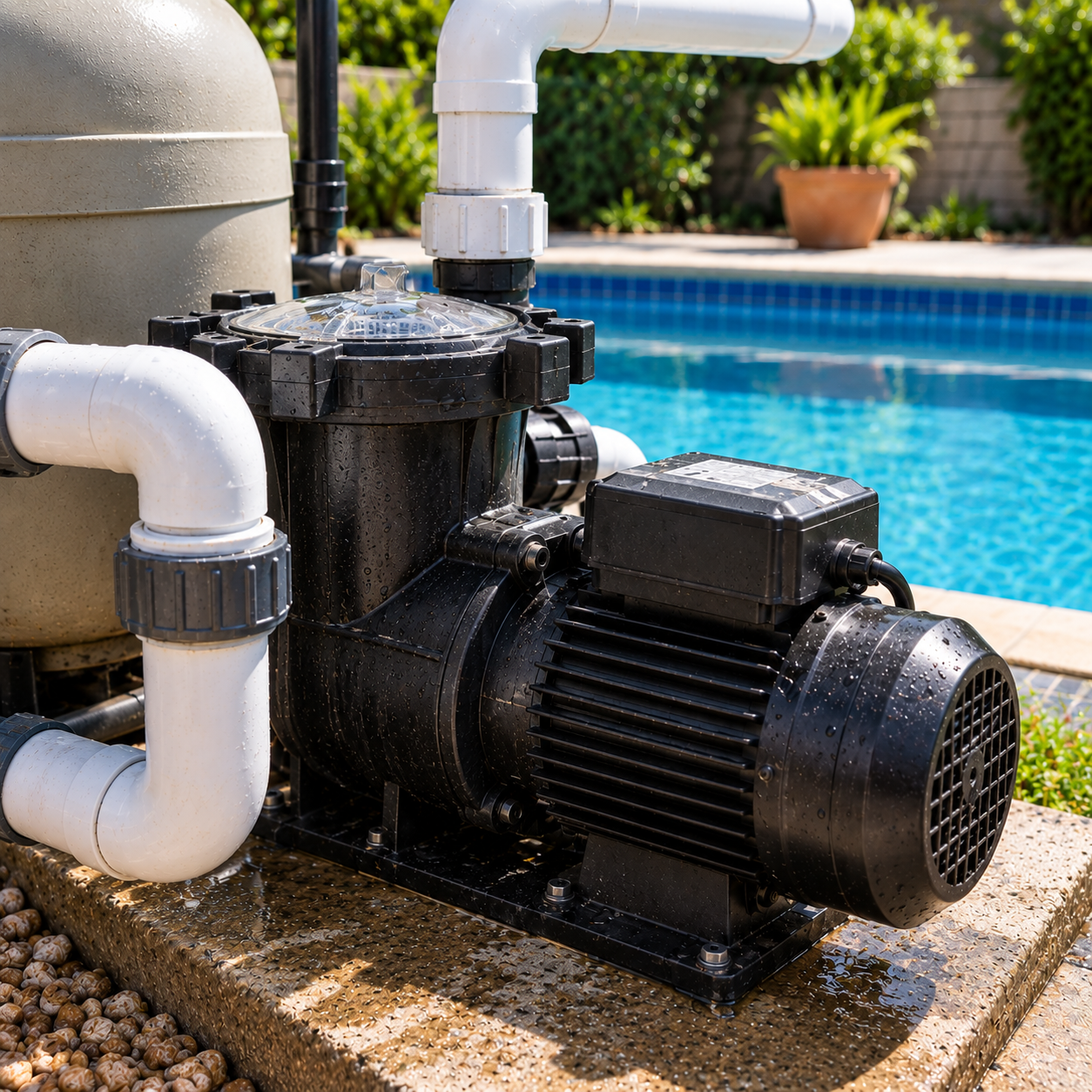
You switch the pool pump on, watch the clear lid, and expect to see the pump fill with water and begin circulating normally. Instead, the water level inside the pump housing keeps dropping, air bubbles appear, or the pump runs without establishing proper flow.
Then you switch it off, wait a while and try again. Sometimes it primes. Sometimes it does not. It may work perfectly for a few hours before losing prime again.
A pump that repeatedly loses prime is telling you that something in the circulation system is not working as it should.
The cause is not always the pump itself. Low pool water, air entering the suction line, a blocked pipe, a damaged valve, a leaking connection or a problem with the pump can all produce similar symptoms. Finding the actual cause matters because simply repriming the pump may only keep the problem going rather than fixing it.
At Absolute Pools, we look at the pump together with the connected circulation system when investigating problems such as loss of prime, weak suction and poor water flow. The aim is to identify what is preventing the system from maintaining normal circulation rather than automatically replacing the pump.
Need Help With a Pump That Keeps Losing Prime?
Tell Absolute Pools what your pump is doing, when it loses prime and what you have already noticed so we can assess the likely cause and recommend the right repair.
What Does It Mean When a Pool Pump Loses Prime?
“Prime” refers to the pump being filled with water so that it can move water properly through the circulation system.
A pool pump is designed to draw water from the pool, move it through the pump and filtration equipment, and return it to the pool.
When the pump is properly primed, the pump housing should remain filled with water while the system is operating normally.
When it loses prime, air enters the system or water is no longer reaching the pump as it should. The pump may then struggle to establish or maintain normal flow.
You might notice the water inside the pump basket dropping. The pump may make a different sound. Air bubbles may appear beneath the clear lid, and the return jets may have weaker flow than usual.
Sometimes the pump will prime again after being filled manually. That can make the problem seem solved.
But if it repeatedly loses prime, something is causing the system to lose water or draw in air.
That underlying issue needs to be found.
The Most Common Cause: Air Entering the Suction Line
One of the first things we consider when a pump repeatedly loses prime is air entering the suction side of the circulation system.
The suction side is the section that carries water from the pool towards the pump.
Under normal conditions, the pump draws water through this line. If air gets into the system through a faulty connection, damaged pipe, valve or fitting, the pump may struggle to maintain a continuous flow of water.
The difficulty is that an air leak does not always behave like a conventional water leak.
A damaged return pipe can allow water to escape when the pump is operating. A suction-side problem can instead allow air to enter while the pump is trying to draw water towards itself.
That means you might not find a puddle or visibly wet area around the suspected problem.
This is particularly relevant with underground pool plumbing.
A suction pipe can have a problem beneath paving or soil without producing an obvious surface leak. The symptoms may instead appear at the pump as bubbles, weak suction or repeated loss of prime.
Absolute Pools identifies air entering the suction line as one of the possible causes of poor circulation and pump problems, alongside blocked plumbing, low water levels, damaged valves and other faults.
Check the Pool Water Level First
Before assuming that there is a damaged pipe, check the simplest possibility: the pool may not contain enough water.
The skimmer needs an adequate water level for the circulation system to operate correctly.
If the water drops below the appropriate level, the skimmer can begin drawing air instead of a continuous supply of water. That air eventually reaches the pump and can cause it to lose prime.
This can happen after a period of water loss, particularly during hot weather when evaporation is higher.
It can also happen if the pool has a leak that has not yet been identified.
That creates an important distinction.
Low water may be the immediate reason the pump is losing prime, but it does not necessarily explain why the pool became low in the first place.
If you keep topping up the pool and the pump continues losing prime a few days later, the water level itself may be a symptom of a larger problem.
Persistent water loss should therefore be investigated rather than treated simply by adding more water.
A Dirty or Blocked Pump Basket Can Affect Circulation
The pump basket catches debris before it reaches the pump.
Leaves, grass and other debris can accumulate inside the basket, especially after windy weather or heavy pool use.
If the basket becomes heavily blocked, water flow into the pump can be restricted.
This can contribute to poor circulation and may make the pump appear to be struggling.
Checking and cleaning an accessible pump basket is a normal part of pool maintenance.
However, there is a difference between a blocked basket and a pump that repeatedly loses prime despite a clean basket.
If the basket is clean and the problem continues, it is time to consider what else may be restricting or interrupting the water supply.
A blocked skimmer basket can create a similar issue.
If debris is restricting the flow before water even reaches the pump, the pump may not receive the volume of water it needs.
That is why checking the obvious maintenance points first is worthwhile, but it should not become an excuse to keep cleaning baskets when the underlying problem is somewhere else.
Could a Blocked Pool Pipe Be the Problem?
Yes.
Pool plumbing can become restricted by debris, particularly in suction, cleaner or skimmer lines.
A partial blockage may reduce water flow enough to make the pump struggle.
A more severe obstruction can prevent the pump from drawing water effectively through the affected line.
The symptoms can resemble other problems.
You may notice weak suction at the weir. The automatic cleaner may move poorly or stop altogether. The pump may struggle to prime, while the return flow becomes weaker than usual.
This is why a pump that keeps losing prime should not automatically be treated as a pump failure.
The pump may be working, but it may not be receiving water properly.
Absolute Pools’ pool plumbing service covers leaking, cracked and blocked pool pipes, with the circulation system inspected to distinguish a plumbing fault from problems such as a faulty pump, damaged valve or low water level.
What Happens If the Suction Pipe Is Leaking?
A suction-side pipe leak can be particularly difficult to identify because it may not produce the kind of visible water loss people expect from a broken pipe.
The pump is creating suction as it draws water from the pool.
If there is a weakness in the suction plumbing, air can enter the line.
That air may then reach the pump.
You might see bubbles in the pump basket or notice that the pump struggles to remain fully primed.
The automatic cleaner may also perform poorly if the affected line is associated with cleaner suction.
An underground suction pipe can make the situation even more difficult because the damaged section may be hidden beneath the pool surround.
There may be no obvious wet patch to point towards the problem.
If you are dealing with repeated loss of prime and unexplained air entering the system, suction-side plumbing needs to be considered.
What About the Pump Lid and O-Ring?
The pump itself has several points where air can potentially enter.
One of the most accessible is the clear pump lid and its sealing O-ring.
If the lid is not sealing correctly, air can enter the pump.
The O-ring may have deteriorated, become damaged or not be seated correctly. Dirt around the sealing surface can also prevent a proper seal.
This is one of the reasons it is useful to inspect accessible components before assuming that an underground pipe has failed.
A small sealing problem near the pump can produce symptoms that look much more serious than the actual repair required.
However, if the lid and O-ring appear to be in good condition and the pump still loses prime, the investigation needs to move further through the circulation system.
Other connections, valves, unions and plumbing sections can also be involved.
Could a Valve Be Allowing Air Into the System?
Valves control the movement of water through different sections of pool plumbing.
A damaged or poorly sealing valve can interfere with normal circulation.
Depending on its position and condition, it may contribute to restricted flow or allow air into the suction system.
This is particularly relevant when a pool has multiple suction lines or plumbing configurations that allow water to be drawn from different parts of the system.
A valve problem can sometimes be overlooked because the pump itself may appear to be the obvious source of the trouble.
But the pump is only one part of the system.
If the pump loses prime after the plumbing configuration is changed, or the problem is associated with a particular suction line, valves should form part of the assessment.
Air Bubbles in the Pump Basket Are an Important Clue
Take a look through the clear pump lid while the pump is running.
A small amount of movement or occasional bubbles does not automatically prove that there is a major leak.
However, persistent air bubbles can be useful evidence.
If the pump basket appears to fill with water and then becomes increasingly full of air, there may be an interruption somewhere on the suction side.
The exact source could be close to the pump or much further along the plumbing.
This is why the location of the bubbles does not tell you exactly where the fault is.
The air is simply showing you that the system is not maintaining the solid column of water that the pump needs.
If the bubbles are accompanied by weak suction, poor cleaner movement and repeated loss of prime, the case for investigating the suction system becomes stronger.
Losing Prime Again and Again?
If you have to reprime the pump repeatedly, Absolute Pools can inspect the pump and circulation system to determine why it is failing to maintain normal water flow.
Why Does the Pump Prime Initially but Then Lose It?
This is one of the more frustrating versions of the problem.
You fill the pump with water, start it and everything appears normal.
For a while, the pump operates correctly.
Then the water inside the pump basket starts dropping, air appears and the pump loses its prime again.
That pattern suggests that the system can establish circulation temporarily but cannot maintain it.
The cause could be a small air leak, a suction-side plumbing problem, a restriction or another issue that becomes apparent once the system has been operating.
A small fault can sometimes be more difficult to identify than a complete failure because the equipment is capable of working under certain conditions.
This is why the timing matters.
If the pump loses prime immediately after starting, that provides different information from a pump that runs normally for two hours and then gradually fills with air.
Pay attention to the sequence.
It can help narrow down the investigation.
Does Pump Speed or Running Time Matter?
It can.
The circulation system does not necessarily behave identically under every operating condition.
A small restriction or air leak may become more noticeable as the pump operates for longer.
Similarly, a problem may only become obvious once the water level drops slightly or the system has been running continuously.
If you notice that the pump loses prime after a particular period of operation, make a note of it.
Does it happen after 20 minutes?
A few hours?
Only overnight?
Only after the pump has been switched off and restarted?
That information can be useful when diagnosing the fault because it gives a clearer picture of how the system behaves rather than simply describing the pump as “losing prime.”
Could the Filter Be Causing the Problem?
A dirty filter can restrict water flow and contribute to circulation problems.
However, a dirty filter does not necessarily explain every case of loss of prime.
The pump and filter operate together, but the problem can occur before the water reaches the pump, within the pump itself or elsewhere in the circulation system.
A severely restricted filter can affect the system’s ability to move water efficiently, while a suction-side problem can prevent enough water from reaching the pump in the first place.
This is why replacing filter sand or servicing the filter should not automatically be the first response to a pump that keeps losing prime.
The system needs to be assessed according to the symptoms.
Absolute Pools provides pool filter repairs and sand changes, but its pump repair service also specifically notes that weak circulation can be caused by several issues beyond the pump itself, including a dirty filter, blocked plumbing, low water level and air entering the suction line.
Could a Leaking Pool Be Causing the Pump to Lose Prime?
It can, indirectly.
If the pool is losing water, the water level can eventually fall low enough to interfere with the skimmer.
The pump then receives an inconsistent supply of water and may begin drawing air.
This creates a connection between two problems that may initially seem unrelated.
You may think the pump is losing prime because the pump is faulty.
But the pump could actually be responding to a falling pool water level.
And the falling water level could be caused by a leak elsewhere.
This is why recurring loss of prime and unexplained water loss should be investigated together.
Absolute Pools’ leak detection service considers the pool shell, fittings, plumbing and equipment because water loss can originate from several different parts of the system.
What If the Pool Is Losing Water Only While the Pump Runs?
That pattern is particularly interesting.
If water loss becomes noticeably worse while the pump is operating, pressurised return plumbing may need to be considered.
The return side of the circulation system carries filtered water back towards the pool under pressure while the pump is running.
A damaged return pipe can therefore release water into the ground during operation.
That is different from a suction-side leak, where air can enter the system as the pump draws water towards itself.
The two problems can produce different clues, although symptoms can overlap.
If your pump loses prime and you are also seeing a noticeable drop in pool water while the system operates, both the plumbing and pump should be assessed.
The fact that the pump is losing prime does not necessarily mean that the pump is the original source of the problem.
Why Repeatedly Repriming the Pump Is Not a Real Fix
Repriming the pump can restore circulation temporarily.
It does not necessarily address why the pump lost prime.
If the underlying fault remains, you may find yourself repeating the same process every day or every few days.
That becomes particularly problematic when the pump is allowed to run without sufficient water.
Pool pumps should not be allowed to run dry.
The water provides an essential part of the operating conditions for the pump, and continued operation without proper water flow can contribute to equipment damage.
Absolute Pools specifically advises against allowing a pump to run dry or repeatedly restarting a pump that is overheating, tripping or showing other warning signs.
If you have to keep repriming the pump, the better question is not “How do I prime it again?”
It is “Why does it keep losing prime?”
That change in thinking is what moves you from repeatedly treating the symptom towards finding the cause.
What Can You Safely Check Yourself?
There are a few straightforward things worth checking before arranging professional assistance.
Make sure the pool water is at an appropriate level.
Check that the skimmer basket and pump basket are not clogged.
Look at the pump lid and accessible sealing area for obvious damage or dirt.
Observe the pump while it operates and note whether there are persistent air bubbles.
Check the visible plumbing around the pump for obvious leaks, loose connections or damaged fittings.
If the pump has a valve configuration, make sure valves have not been accidentally moved from their normal operating positions.
These checks can help identify simple issues.
They do not require you to dismantle the pump.
Once the investigation involves opening electrical components, accessing concealed plumbing or testing underground pipework, DIY stops being a sensible approach.
What You Should Not Do
Do not repeatedly switch a failing pump on and off simply to see whether it will eventually prime.
Do not allow the pump to continue running without adequate water flow.
Do not start digging up paving because you suspect there is an underground pipe leak.
And do not pour household drain-cleaning chemicals into pool plumbing in an attempt to clear a suspected blockage.
Pool plumbing problems can have several causes, and the wrong repair can create additional damage.
For example, if the actual problem is a faulty pump lid seal, excavating the garden will achieve nothing.
If the problem is an underground suction pipe, repeatedly replacing pump components will not solve it.
Diagnosis should come before major repair work.
When Should You Call a Pool Professional?
If the pump repeatedly loses prime despite an adequate water level and clean baskets, the problem deserves further investigation.
The same applies if you notice persistent air bubbles, weak suction, poor cleaner movement, reduced return flow or unexplained water loss.
A pump that loses prime once after a simple maintenance issue is different from a pump that loses prime repeatedly.
The repeated pattern is what matters.
Professional assistance becomes particularly useful when the suspected problem involves concealed plumbing.
Underground pipes cannot be properly assessed simply by looking at the pump.
Absolute Pools’ plumbing service covers visible and underground pool pipes, suction lines, return lines and fittings. Where the location of an underground leak is unknown, the company notes that leak detection or pressure testing may be required before repairs begin.
How We Approach a Pool Pump That Keeps Losing Prime
At Absolute Pools, we do not start by assuming that every loss-of-prime problem means the pump needs replacing.
Our approach is to look at the pump and the connected circulation system.
We consider the water level, visible plumbing, suction and return conditions, pump operation and other symptoms that may help identify the cause.
That matters because several problems can produce similar symptoms.
A low water level can look like a suction problem.
A blocked pipe can make a working pump appear faulty.
A damaged valve or connection can introduce air.
A leaking underground pipe may have no visible sign at the surface.
And a genuine pump fault can also be responsible.
The repair therefore depends on what the assessment finds.
Absolute Pools’ pool repair process is based on inspection and assessment first, followed by a practical repair plan and quotation before the necessary repairs are carried out.
Repair or Replace the Pump?
A pump that keeps losing prime does not automatically need replacement.
If the pump itself is in good condition and the problem is caused by a damaged seal, connection, valve or plumbing issue, replacing the entire unit would not address the real cause.
Likewise, if the pump has a specific repairable fault, repairing the affected component may be more practical.
Replacement becomes more relevant when the pump is badly damaged, the housing is cracked, the motor has significant damage, compatible parts are unavailable or previous repairs have failed to restore reliable operation.
The age and overall condition of the pump also matter.
Absolute Pools assesses whether a pump is suitable for repair or whether replacement is more practical, taking into account the condition of the unit and the availability of replacement components.
The goal is not to repair everything indefinitely.
It is to find the solution that makes sense for the actual condition of the equipment.
What Does an Underground Plumbing Problem Have to Do With Prime?
Quite a lot.
The pump depends on the plumbing to deliver water continuously.
If a suction line is cracked or has a faulty connection, the pump may struggle to draw water without introducing air.
If a return line is leaking, water can escape while the pump is operating.
If a pipe is blocked, the pump may be starved of sufficient flow.
All three problems involve plumbing, but they require different repairs.
This is why a pool pump problem should sometimes be investigated beyond the equipment pad.
The pump may simply be where the symptoms become visible.
The actual fault could be somewhere else in the circulation network.
What Can Happen If the Problem Is Ignored?
The immediate consequence is usually poor circulation.
But the effects can spread beyond the pump.
If the pump cannot maintain proper flow, filtration becomes less effective. Water may become cloudy or dirty, and maintaining the pool’s chemistry can become more difficult.
If the pool is also losing water, continued topping up increases water use and can require additional chemical adjustment.
If an underground plumbing leak is present, escaping water can also affect surrounding soil and paving.
Not every leak will cause visible damage, but persistent water escaping beneath a pool surround should not be dismissed.
And if the pump is repeatedly losing prime because it is not receiving enough water, allowing it to operate under those conditions can place unnecessary strain on the equipment.
The longer the problem continues, the more likely it is that a simple fault becomes a larger repair.
How Much Does It Cost to Fix a Pump That Keeps Losing Prime?
There is no useful single price for this type of repair because “losing prime” describes a symptom rather than one specific fault.
The cost depends on what is causing the problem.
A damaged O-ring or accessible connection is very different from an underground pipe that needs to be located and repaired.
Likewise, a blocked pipe may require a different type of work from a damaged pump, valve or other component.
Access can also affect the work required.
An exposed connection beside the pump is relatively straightforward to reach. A damaged pipe beneath paving, concrete or another pool surround may require additional access work after the affected section has been located.
Absolute Pools states that pool plumbing repair costs depend on factors including the location and extent of damage, depth of plumbing, site access, affected lines and the type of surface above the damaged area.
That is why an assessment is more useful than trying to estimate the repair from the symptom alone.
A Pump That Keeps Losing Prime Is Trying to Tell You Something
A pool pump should not repeatedly lose prime as part of normal operation.
If it does, there is a reason.
The cause may be as simple as an inadequate water level or blocked basket. It could involve the pump lid seal, a valve, restricted plumbing or air entering the suction side. In other cases, the problem may involve underground pipework or the pump itself.
The important thing is to look beyond the fact that the pump needs to be reprimed.
Repriming restores operation temporarily, but it does not explain why the water disappeared from the pump in the first place.
Start with the simple checks. Make sure the pool has enough water, clean the accessible baskets and observe what happens when the pump runs. Pay attention to air bubbles, weak suction, changes in return flow and any unexplained water loss.
If the pump continues losing prime, the circulation system needs to be investigated properly.
At Absolute Pools, we assess the pump and the wider pool system to identify the likely cause before recommending repair or replacement. That means the solution can be based on what is actually wrong with the pool rather than on the assumption that a struggling pump automatically needs to be replaced.
A pump that keeps losing prime is not simply being difficult. It is usually showing you that water or air is moving through the system in a way it should not.
Finding out why is the first step towards getting the circulation back to normal.
Ready to Stop Repriming the Pump?
If your pool pump keeps losing prime, Absolute Pools can assess the pump, plumbing and circulation system to identify the likely cause and recommend the appropriate repair.

Comments are closed