


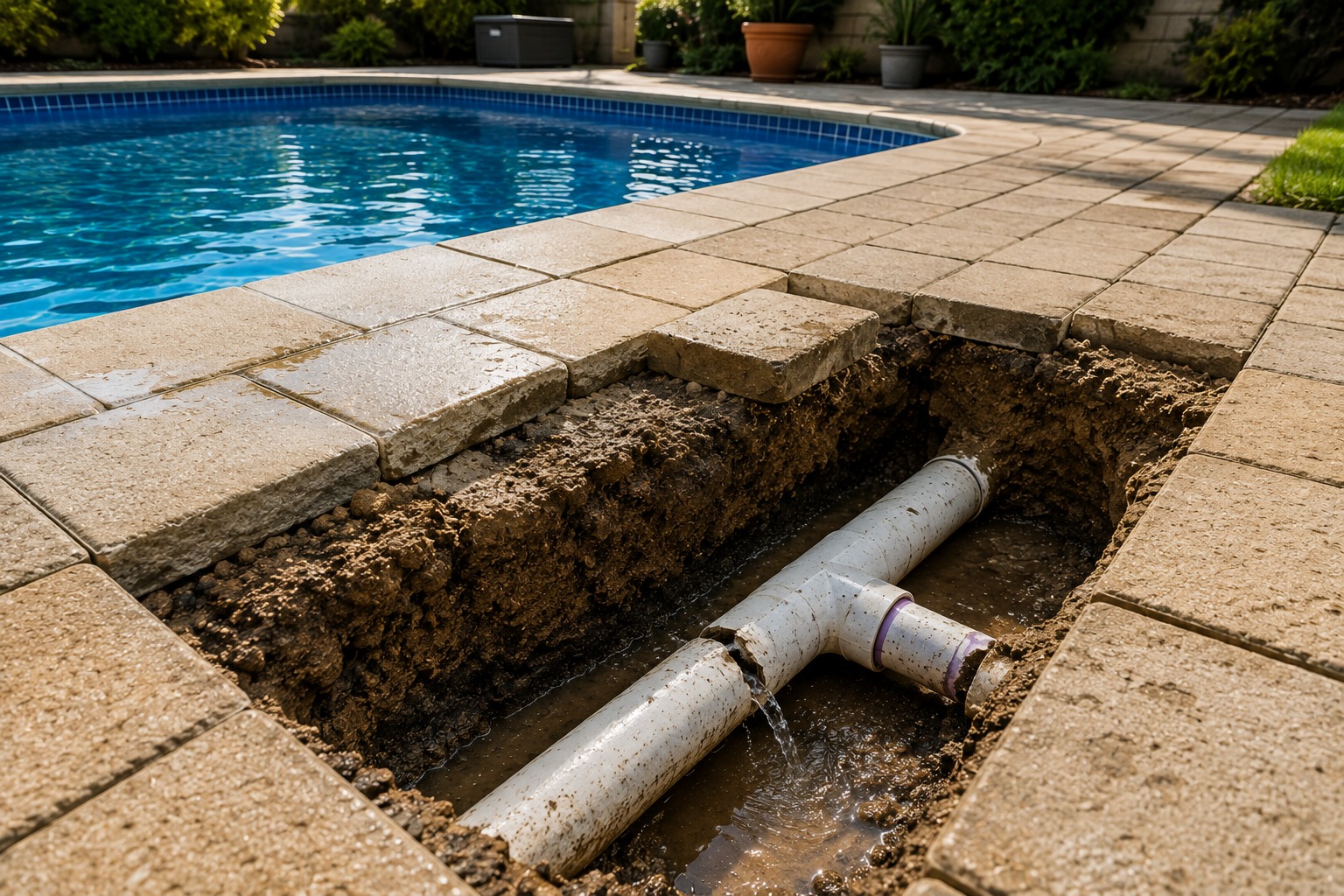
A pool that keeps losing water can leave you with a deceptively simple problem: the water level drops, but there is no obvious leak to see.
There is no puddle beside the pool. Nothing is dripping from the pump. The paving may look completely normal. Yet you keep adding water, sometimes several times a week.
When that happens, the plumbing beneath the pool area deserves attention.
Pool pipes carry large volumes of water between the pool, pump, filter and other parts of the circulation system. Much of that pipework is hidden underground, beneath paving, soil or landscaping. If a pipe cracks, separates at a joint or develops another fault, the water can escape somewhere that is impossible to see from the surface.
An underground pool pipe leak does not always announce itself dramatically. Often, it starts with small changes that are easy to dismiss. The pool needs topping up more often. One patch of paving stays damp. The pump starts behaving differently. The water level drops faster when the circulation system is operating.
Those clues become much more useful when they are considered together.
At Absolute Pools, we look at the pool, equipment, visible symptoms and plumbing as part of the same system when investigating unexplained water loss. Our pool plumbing and pipe repair service covers leaking, cracked and blocked pool pipes, as well as affected fittings.
Book a Pool Leak Assessment
Fill in the form below and tell us how quickly your pool is losing water and when you first noticed the problem. Our team will contact you to discuss the next step.
1. Your Pool Keeps Losing Water Without an Obvious Explanation
The first and most obvious warning sign is persistent water loss.
Every outdoor pool loses some water naturally. Evaporation, splashing, cleaning and other normal activities can all lower the water level. The important question is whether the amount of water being lost is consistent with normal use and weather conditions.
A pool that suddenly needs significantly more topping up than before deserves closer attention.
For example, perhaps you normally add a little water every few days during hot weather. Now the level drops noticeably overnight, or you are adding water almost every day just to keep the pool at its normal operating level.
That does not automatically prove that an underground pipe is leaking. The leak could be elsewhere in the pool system, or the water loss could have another explanation.
But unexplained, persistent water loss is the starting point for a proper investigation.
The pattern also matters.
If the pool appears to lose water regardless of whether the pump is operating, the problem may need to be investigated across the pool shell, fittings, plumbing and equipment.
If the water loss becomes noticeably worse when the pump is running, circulation plumbing becomes particularly relevant because water is being moved through the system under operating conditions.
This is one reason we do not recommend simply adding water indefinitely and hoping the problem settles down.
The water level itself is giving you information.
2. The Water Loss Changes When the Pump Runs
A change in water loss associated with pump operation is one of the more useful clues when investigating pool plumbing.
When the pump is switched on, water is drawn from the pool and circulated through the filtration system before returning to the pool.
The conditions inside the plumbing change as the system operates.
If a pressurised return pipe has developed a crack or failed connection underground, water may escape into the surrounding ground while the pump is running. Once the pump stops, that pressure disappears and the rate of leakage may change.
That can produce a very noticeable pattern.
You may find that the pool holds its level reasonably well while the pump is off, but after several hours of filtration, the water level has dropped considerably.
This does not mean that the pump itself is necessarily leaking.
The problem could be somewhere along the return line.
It could also involve another part of the circulation system, which is why the pump-running pattern should be treated as a clue rather than a diagnosis.
There is an important distinction here. A pump does not need to be physically next to a leak for its operation to affect the amount of water being lost. The pump changes the pressure and movement of water throughout the connected plumbing.
That is why an underground pipe can leak more significantly during circulation while remaining difficult to detect visually.
3. You Notice Damp or Unusually Wet Ground Near the Pool
Water escaping from an underground pipe has to go somewhere.
Sometimes, it eventually makes its way to the surface.
A persistently damp patch of soil, grass or paving near the pool can therefore provide an important clue.
You may notice that one section of the garden remains wetter than the surrounding area even after several dry days. Perhaps a patch of paving looks darker than normal, or the ground seems unusually soft.
The location can be useful, but it should not be treated as an exact map of the leak.
Water moves through soil.
If a pipe is leaking beneath one section of paving, the water may travel along the surrounding ground before appearing somewhere else. The wet patch may therefore be close to the damaged pipe without being directly above it.
There are also other reasons for wet ground.
Irrigation systems, rainwater, drainage problems and ordinary garden watering can create similar symptoms.
This is why we look for patterns rather than relying on one observation.
If the damp area becomes noticeably wetter when the pool pump operates, while the pool is also losing water, the combination becomes more significant.
A wet patch that appears once after heavy rain is very different from an area that remains damp repeatedly despite otherwise dry conditions.
4. The Pool Level Drops Faster Than Evaporation Can Explain
Evaporation is often the first explanation people consider when a pool loses water.
And sometimes evaporation really is responsible.
Hot weather, direct sunlight, wind and low humidity can increase evaporation. Splashing and normal pool use also contribute to water loss.
The difficulty is knowing when the amount of water being lost has moved beyond what those factors reasonably explain.
A simple bucket test can help.
Fill a bucket with pool water and place it on a pool step or another stable location where the bucket can remain undisturbed. Mark the water level inside the bucket and compare it with the water level in the pool over the same period.
Because both the bucket and pool are exposed to the same general environmental conditions, the comparison can provide a useful indication of whether the pool is losing water significantly faster than evaporation.
The bucket test does not identify an underground pipe leak.
It also does not tell you where a leak is located.
Its purpose is simply to help distinguish ordinary environmental water loss from a situation that warrants further investigation.
If the pool level falls substantially more than the bucket level, there is a reason to investigate the possibility of a leak.
At that point, the next question becomes more specific: is the water escaping through the pool structure, a fitting, the plumbing or the equipment?
That is where proper leak detection becomes useful.
5. The Pool Has Weak Suction or Poorer Circulation
An underground pipe problem does not always present itself as obvious water loss.
You may also notice a change in the way the circulation system behaves.
For example, the skimmer may not appear to have the same suction it normally does. Water returning through the pool inlets may seem weaker. The pump may struggle to maintain normal circulation.
A leak on the suction side of the plumbing can allow air to enter the system rather than allowing the pump to draw water efficiently.
This can result in air bubbles in the pump basket or visible bubbles returning into the pool.
However, weak suction does not automatically mean that an underground pipe is leaking.
A blocked basket, dirty filter, valve problem, low water level or another circulation issue can create similar symptoms.
The important thing is to consider the symptoms together.
Weak circulation on its own might be a maintenance issue.
Persistent water loss on its own might have several possible causes.
Persistent water loss combined with air entering the system and unusual pump behaviour gives us a much stronger reason to investigate the plumbing.
Absolute Pools specifically identifies leaking, cracked or blocked pool pipes as potential causes of water loss, poor suction and weak circulation.
6. Your Pump Is Pulling in Air or Struggling to Stay Primed
A healthy circulation system should be able to maintain a consistent flow of water.
If air repeatedly enters the system, you may notice it in the pump basket or through bubbles returning into the pool.
You may also find that the pump loses prime after being switched off and struggles to establish normal circulation again.
There are several possible reasons for this.
The pool water level may be too low. A skimmer basket may be blocked. A valve may not be positioned correctly. A connection may be allowing air into the suction line.
An underground suction pipe can also be part of the investigation.
This is where it is important not to jump straight to replacing the pump.
A pump that is struggling to maintain prime is not necessarily a failed pump.
The pump may be reacting to a problem elsewhere in the system.
For example, if the pump is capable of circulating water normally under some conditions but repeatedly loses prime after operating for a period, the plumbing and suction system need to be considered alongside the pump itself.
A professional assessment can help separate a pump fault from a plumbing fault.
That distinction can save you from replacing functioning equipment when the actual problem is hidden in the pipework.
7. You Notice Changes Around the Pool or Paving
Underground water leaks can sometimes affect the area surrounding the pool.
You might notice paving that has started to sink slightly, a section of ground that feels softer than usual, or an area that repeatedly becomes damp.
In more persistent cases, movement in the surrounding ground can become noticeable.
This does not mean that every cracked or uneven section of paving is evidence of a pool pipe leak.
Paving can move for many reasons, including ordinary settlement, poor drainage, age and changes in the underlying ground.
But when changes in the pool surround occur alongside unexplained water loss, they are worth mentioning during an assessment.
The same principle applies to landscaping.
If one area near the pool seems unusually wet or vegetation appears different from surrounding areas, that observation can help narrow down where escaping water may be travelling.
We do not assume that the visible damage identifies the pipe location. Instead, we use it as another piece of information when assessing the wider system.
Absolute Pools also repairs pool coping, paving and surrounding areas where damage or movement has occurred, making it important to distinguish a plumbing problem from damage that is purely related to the pool surround.
Where Can an Underground Pool Pipe Leak Occur?
Pool plumbing is not one continuous pipe running from the pool to the pump.
There are multiple sections and connections within a typical circulation system.
Water may travel from the pool through suction lines towards the pump. From there, it passes through filtration equipment before being returned to the pool through return plumbing.
There may also be valves, unions, fittings and other connections within the system.
Any of these areas can potentially develop a problem.
A pipe can crack.
A connection can deteriorate.
A fitting can become damaged.
A section of plumbing can become blocked or restricted.
The exact cause depends on the installation, materials, age and condition of the system.
Underground plumbing is particularly difficult because the pipe itself is inaccessible without disturbing the surrounding area.
That is why diagnosis should come before unnecessary excavation.
Why Underground Leaks Are So Difficult to Find
A leaking pipe beneath a pool surround does not behave like a leaking tap.
With a tap, you can see the water escaping directly from the damaged component.
Underground plumbing is hidden.
The escaping water enters the soil, and the soil determines where that water travels.
It may move sideways.
It may move deeper into the ground.
It may collect around a particular area.
It may eventually reach the surface somewhere away from the damaged section.
This makes visual inspection alone unreliable.
The absence of a puddle does not mean there is no underground leak.
Likewise, finding a damp patch does not necessarily tell you exactly where the pipe has failed.
This is one reason leak detection should be approached systematically.
Is the Leak on the Suction Side or Return Side?
This distinction can help narrow down the problem.
The suction side carries water from the pool towards the pump.
If this section has a fault, air can potentially enter the system. You may notice bubbles, poor suction or difficulty maintaining prime.
The return side carries filtered water back towards the pool.
Because the pump is pushing water through this part of the system, a damaged return pipe can release water into the ground while the pump is operating.
The symptoms can overlap, so this is not something that should be diagnosed from one sign alone.
However, understanding the difference helps explain why a pool can lose water in different ways depending on where the plumbing problem occurs.
It also explains why a pump can sometimes appear to be malfunctioning when the underlying issue is actually in the pipework.
What Can Cause an Underground Pool Pipe to Leak?
There is no single cause.
Pipework can deteriorate over time. Connections and fittings can fail. Physical damage can occur around underground plumbing. Ground movement can place stress on components, while previous repair work or alterations can introduce another potential failure point.
The age and condition of the entire system matter.
Older pools can have plumbing that has been repaired, modified or replaced at different times. A section of newer pipework may therefore be connected to older components.
That does not mean an older pool automatically has a plumbing problem.
It simply means the history and condition of the system are useful when determining what needs to be investigated.
Can a Blocked Pipe Look Like a Leaking Pipe?
Sometimes the symptoms can overlap.
A blocked or restricted pipe can cause poor circulation, weak suction or difficulty moving water through the system.
Those symptoms may occur alongside other problems, making it difficult to determine the cause without examining the system.
A genuine leak can also result in poor circulation if enough water is being lost or if air is entering the system.
This is why the diagnosis should not stop at “the pump isn’t circulating properly.”
The question is why the circulation has changed.
Is there a blockage?
Is the water level too low?
Is the pump faulty?
Is air entering the suction line?
Is a valve malfunctioning?
Or is there a leak somewhere in the plumbing?
The answer determines the appropriate repair.
Can You Find an Underground Pool Leak Yourself?
There are a few observations you can make without specialist equipment.
You can monitor the pool’s water level.
You can perform a bucket test to compare water loss with evaporation.
You can check accessible areas around the pump and filter for visible leaks.
You can observe whether water loss changes when the pump is operating.
You can look for recurring damp patches around the pool.
These observations are useful because they establish a pattern.
What you should avoid is randomly digging up the pool surround because you suspect that a pipe may be leaking underneath it.
Without knowing where the damaged section is, excavation can create unnecessary damage and additional repair work.
You may remove paving from one area only to discover that the actual problem is several metres away.
Underground plumbing is one of those situations where a little investigation before breaking ground can make a significant difference.
What Does Professional Pool Leak Detection Involve?
The exact process depends on the pool and the symptoms.
We start by assessing the visible evidence and understanding the pattern of water loss.
The pool shell, fittings, plumbing and equipment all need to be considered because water can escape through several different routes.
Where appropriate, further testing can help narrow down the source.
The purpose is not simply to confirm that the pool is losing water. You already know that if you are repeatedly topping it up.
The useful question is where the water is escaping.
Absolute Pools provides pool leak detection and repairs, investigating the shell, fittings, plumbing and equipment to identify the likely source before recommending repairs.
That approach is particularly valuable when the suspected leak is underground because it helps avoid treating the surrounding paving or garden as the starting point for a guessing exercise.
What Happens Once a Leaking Pipe Is Located?
Finding the leak is only the first part.
The next decision is how best to access and repair the affected section.
If the damaged plumbing is accessible, the repair may be relatively straightforward.
If it is beneath paving, the work may involve carefully accessing the affected section before repairing or replacing the damaged pipe or fitting.
The extent of the repair depends on the location and condition of the plumbing.
Sometimes only a specific section needs attention.
In other cases, the investigation may reveal that more extensive plumbing deterioration is present.
This is where the condition of the existing pool becomes important.
If the pool is otherwise in good condition and the problem is isolated, a targeted plumbing repair may be the sensible solution.
If several parts of an older pool are deteriorating at the same time, a wider renovation may make more sense than repeatedly repairing individual failures.
Absolute Pools approaches pool repairs according to the condition of the pool and the specific problem identified, with services ranging from individual plumbing and equipment repairs to broader pool renovations.
Should You Keep Topping Up a Leaking Pool?
Topping up the water can keep the pool operational temporarily, but it does not solve the underlying problem.
There is also a practical limit to how long this makes sense.
Continually adding water means continually replacing water that may be escaping somewhere beneath the property.
If the level drops too far, circulation can also become affected. The skimmer needs an adequate water level to operate correctly, and allowing the level to fall too low can create problems for the pump.
There is another reason not to ignore persistent water loss: the longer an underground leak continues, the more difficult it can become to understand its full impact.
Escaping water may affect the surrounding soil or paving.
That does not mean every underground leak will cause visible structural damage, but it is one more reason to investigate persistent unexplained water loss rather than treating topping up as a permanent solution.
What Information Should You Give Us?
If you contact Absolute Pools about a suspected underground pipe leak, the observations you have already made can be extremely useful.
Tell us approximately how quickly the pool is losing water.
Mention whether the pump was running during the periods when the water level dropped.
Tell us if you have noticed bubbles, weak suction, unusual pump behaviour or changes in return flow.
Point out any recurring damp areas, changes in paving or unusually wet sections of garden.
If you performed a bucket test, explain what happened.
Also mention whether the pool or plumbing has recently been repaired, altered or renovated.
None of these observations provides a diagnosis on its own, but together they can give us a much clearer picture of what needs to be investigated.
Do Not Assume the Visible Symptom Is the Source
This is one of the most important things to remember with pool leaks.
Water can travel.
A wet patch is not necessarily directly above the damaged pipe.
A leaking pump connection does not necessarily mean the pump itself is faulty.
Weak suction does not automatically mean the pump needs replacing.
A falling water level does not automatically mean the pool shell is cracked.
The visible symptom and the actual source can be two different things.
That is why our approach at Absolute Pools is to look at the full system rather than only the most obvious symptom. The company’s repair process begins with inspection and assessment, followed by a practical repair recommendation based on the condition and access before repairs are carried out.
How Much Does an Underground Pipe Repair Cost?
There is no sensible single price for an underground pool pipe leak.
The cost depends heavily on what needs to be found and repaired.
A leaking fitting beside accessible equipment is very different from a damaged pipe beneath a paved pool surround.
Factors such as the location of the leak, accessibility, extent of damage, materials required, labour and the amount of surrounding area that needs to be accessed can all affect the cost.
The investigation itself may also be separate from the repair work because identifying the source and physically repairing it are two different stages.
This is why an accurate assessment is more useful than trying to estimate the cost from the fact that a pool is losing water.
Once the source and extent of the problem are understood, the appropriate repair can be discussed.
Book a Pool Leak Assessment
Fill in the form below and tell us how quickly your pool is losing water and when you first noticed the problem. Our team will contact you to discuss the next step.
When Is a Pool Leak More Urgent?
A small amount of unexplained water loss should not automatically create panic.
But certain combinations of symptoms deserve prompt attention.
If the water level is dropping rapidly, the pump is struggling to operate, air is repeatedly entering the system, or you can see signs of water escaping around the pool or equipment, continuing to operate the system without investigating the cause may not be sensible.
A particularly important situation is when the pool level is falling enough to affect the skimmer.
If the pump begins drawing air because the water level has become too low, you can end up dealing with a circulation problem on top of the original leak.
That is why the sensible approach is to keep the pool at a safe operating level while the problem is being investigated rather than allowing the water level to continue falling unchecked.
What If the Leak Is Not in the Pipe?
This is always a possibility.
A pool that loses water may have a plumbing leak, but it could also have a problem with the pool shell, a fitting, skimmer, light niche, equipment or another component.
A crack in the pool structure can also cause water loss.
The pool finish itself may be deteriorated without necessarily being the primary cause of the leak.
This is why leak detection is valuable.
The purpose is to determine the likely source instead of deciding beforehand that the pipe must be responsible.
Absolute Pools handles different causes of pool water loss, including leak detection and repairs, pool crack and structural repairs, plumbing and pipe repairs and equipment repairs.
The correct repair depends on what the investigation reveals.
What About an Older Pool?
Age does not automatically mean that the plumbing needs to be replaced.
An older pool can continue operating perfectly well if its plumbing and equipment remain in good condition.
But older installations can also have a history of repairs, modifications and component replacements.
If a leak develops, it is worth considering the condition of the surrounding plumbing rather than looking only at the single damaged point.
For example, replacing one failed fitting may be appropriate if the rest of the system is sound.
If several sections are showing deterioration, however, repeatedly repairing one failure after another may not be the most practical long-term approach.
This is where a broader assessment can be helpful.
Absolute Pools works on both individual pool repairs and more comprehensive renovations, with the recommended approach based on the pool’s condition rather than automatically treating every problem in the same way.
The Seven Signs Are More Useful Together
One sign does not prove that you have an underground pool pipe leak.
A damp patch could be irrigation.
Weak circulation could be a dirty filter.
Air in the pump basket could be caused by a suction-side issue that is not underground.
A falling water level could be evaporation or a leak elsewhere in the pool.
But when several signs appear together, the case for investigating the plumbing becomes much stronger.
For example, a pool that is losing water faster than expected, drops more noticeably while the pump is running, has weak suction and repeatedly develops air in the circulation system presents a very different picture from a pool that simply needs a little topping up during a hot spell.
Look at the pattern.
That is usually more informative than any individual symptom.
Finding the Leak Before Repairing the Damage
An underground pool pipe leak is frustrating largely because the problem is hidden.
You can see the water level dropping, but you cannot see where the water is going.
That makes guesswork expensive.
The best starting point is to establish whether the pool is genuinely losing water beyond normal evaporation, observe how the water loss changes when the pump operates and look for other signs such as damp ground, air entering the system, poor suction or changes around the pool surround.
From there, the plumbing can be investigated alongside the pool shell, fittings and equipment.
If the problem is an underground pipe, identifying the affected section before carrying out unnecessary excavation can make the repair process far more controlled.
At Absolute Pools, we approach pool water loss by looking beyond the visible symptom. We assess the pool and its circulation system, identify the likely source and recommend a repair based on the actual condition of the affected area.
A pool pipe leak is much easier to deal with once you know where the water is escaping.
The important thing is not to mistake a hidden plumbing problem for an equipment failure, evaporation or a minor maintenance issue simply because there is no obvious puddle.
Book a Pool Leak Assessment
Fill in the form below and tell us how quickly your pool is losing water and when you first noticed the problem. Our team will contact you to discuss the next step.


Comments are closed